
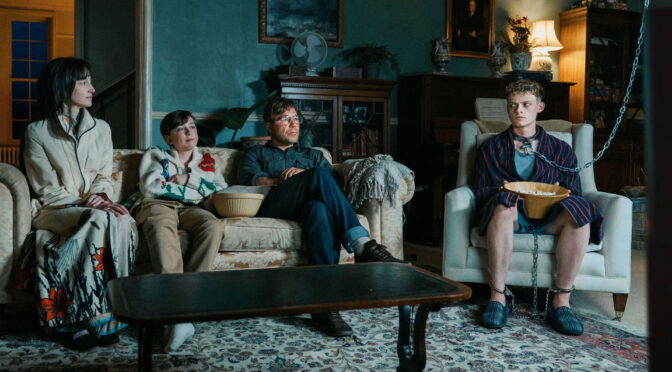
THE GOOD BOY’s establishing shots offer obscene proof that teenage delinquent Tommy (Anson Boon) is not, yet, a ‘Good Boy’: theft, criminal damage, fouling a public place, drunk and disorderly, possession with intent to supply and sexual activity in a public lavatory – eight offences in half as many screen minutes.
Tommy considers his city to be ‘his’. The streets need him, he says. He is King of the streets, he bellows. This perception feeds his diabolic licence to urinate in its bus stops. Tommy knocks about in this manner until middle-aged, middle-class Chris (Stephen Graham) abducts him off the same streets Tommy presumes arrogant kingship over. The abduction scene is choicely edited to obscure the struggle. Without audible screams of protest, the silence of Tommy’s disappearance nips at the edges of this film.
With absurd appearance, Tommy is shaped after a rhetorical category labelled in popular discourse as ‘working class white boys’, a phrase originating from academia published during the era of New Labour multiculturalism. This label retains its initial stereotypes of hostility: a social group stuck in unending bitterness towards immigration and integration policies. However, the Department for Education-esque label has expanded to denote a segment of Brits considered ‘left behind’, disadvantaged, and academically underachieving. Nineteen-year-old Tommy, we will learn, still has to sound out words when reading.
Director Jan Komasa’s aim seems to be a commentary on troubled masculine identities within this rhetorical category. Stephen Graham’s performance as patriarch to a delinquent son-figure is not the only reminder of Netflix’s Adolescence. The specific economic and cultural conditions that THE GOOD BOY, set in Leeds, points to – the indices of deprivation, schooling crises, alienation – are shared in the backdrop to Adolescence’s Sheffield. Indeed, Bartek Bartosik’s screenplay is adapted from its original Polish setting to apply specifically to Northern England. As much as Adolescence and THE GOOD BOY tell stories of young men’s relationship to violence, they also tell stories of England’s North-South divide which, if generalisations are forgiven, imagine a countrywide pattern of skilled labour driven to London and a Northern England left behind, with low public investment and a stagnant economy. As The JAMs proclaimed in 1990, “it’s grim up North.”

“…the relationships must feel genuinely complex for the film’s ethical question to carry weight, and [Anson Boon’s performance as Tommy] makes them so.”
Adolescence picked up on England’s growing concern for its forgotten boys, without overly pandering to viewers’ desire for moral panic. THE GOOD BOY, on the other hand, addresses the same topic through a startlingly unsubtle literalisation of a philosophical question. Chris chains Tommy in his basement not to harm him, but to rehabilitate his anti-social behaviour. Any torture is in service of a higher purpose. In the ethical dilemma set out, Chris personifies a ‘humanitarian’ penal system enforcing moral re-engineering onto its captive: a man-to-man rehearsal of the state-enforced reprogramming in A CLOCKWORK ORANGE. THE GOOD BOY rehearses a well-worn dilemma of free will vs. subjugation: is it moral to force someone to do no harm? Komasa capitalises on Kubrick’s recognisable iconography, using visual shorthand to land the satire of Chris’ own version of the Ludovico Technique conducted through replays of Tommy’s Instagram posts.
Films pivoting around an ethical question can be difficult to watch. The SAW franchise may be responsible for the propagation of a slurry of ontological genre flicks that portray dilemma through metaphor. SAW, questioning how we take our lives for granted, used the metaphor of fatal traps which forced captives to choose between painful survival or weak surrender. THE PLATFORM, questioning the potential for an equal society under the conditions of an avaricious free market, used the metaphor of a platform of food lifted through the floors of a vertical prison. THE CIRCLE, questioning the hierarchies which we use to assign value to human lives, used the metaphor of a game show in which the contestants vote on whom to murder next. Films of this type risk seeming smugly impressed with themselves for engagement with a philosophical question that is often heavy-handed.
Despite its allegory that is as blatant as an audience might expect, THE GOOD BOY packs in a surprising amount of affecting moments. Chris’s young son Jonathan (Kit Rakusen) knows Tommy is a captive. Worryingly tolerant, he treats Tommy as friend, brother, and sometimes pet to whom he models obedience and compliance. Tommy feels discomfort and compassion towards Jonathan, who, unfortunately, notices neither. Tommy’s chains are, after all, just physical. His evolving pity for Jonathan does essential work: the relationships must feel genuinely complex for the film’s ethical question to carry weight, and Boon’s performance makes them so.
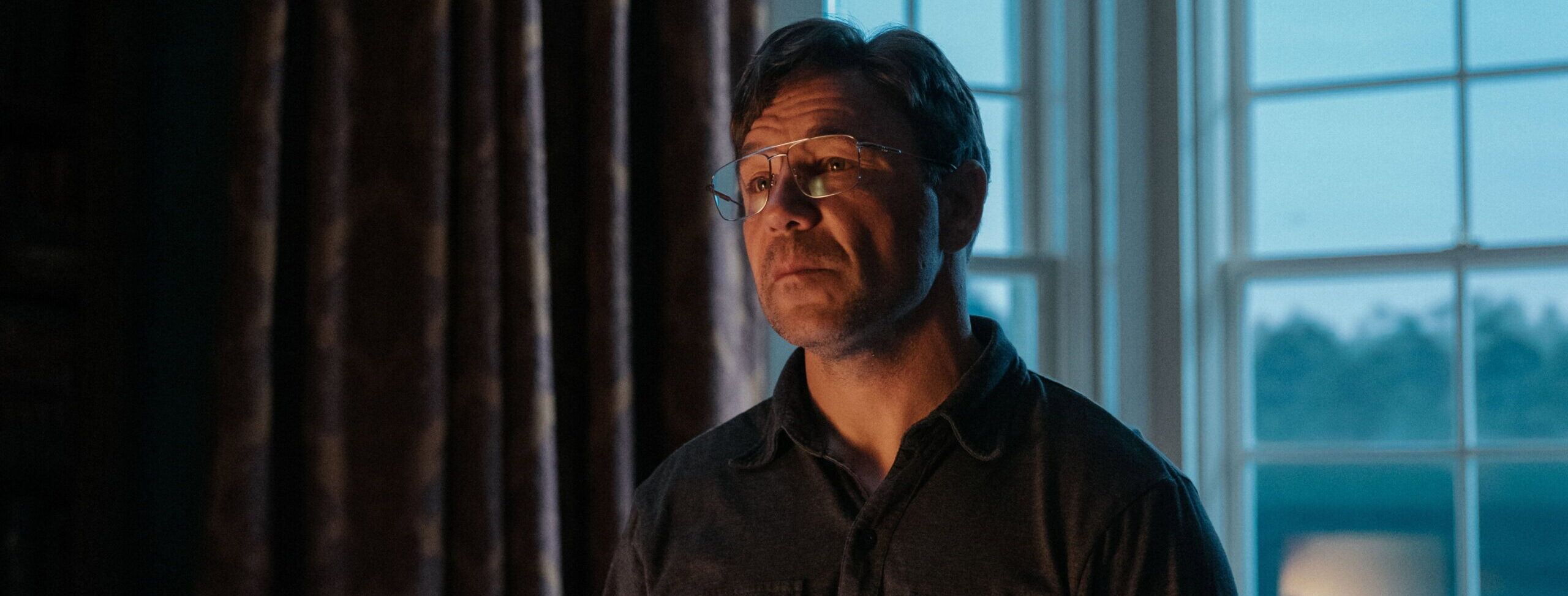
“THE GOOD BOY’s final minutes shift the angle on the question of free will. Instead, we are asked: can punishment ever be justified without certainty of the criminal’s free will?”
THE GOOD BOY’s final minutes shift the angle on the question of free will. Instead, we are asked: can punishment ever be justified without certainty of the criminal’s free will? It is the question Komasa should have been prodding throughout, as it is directly applicable to the film’s Northern England setting that has thus far been primarily sidelined to a mere framing device. Can we blame England’s miscreant young men for their crimes? Any punishment billed as just presupposes that harm was caused freely. But cycles of poverty and failed schooling do not produce free will. They produce, understandably, anger.
This more interesting question, spotlighted too late, is hinted at in the film’s quietest yet finest moments: Chris’ wife Kathryn (Riseborough) notices Tommy squinting during ‘movie night’ and offers him glasses. Tommy’s elation at the glasses’ effect on his sight compacts an entire personal history into one beat: no teacher, no parent, had ever cared enough to tend to Tommy’s basic needs, to see past the bravado to an underlying insecurity that likely stemmed from an early struggle with reading. So how was Tommy ever to succeed? As Tommy’s captor callously remarks: “It’s quite impressive, really. How you’ve managed to aimlessly float through your whole life, completely unnoticed.”
Suddenly, the silence of the kidnapping scene makes sense. No one who should have cared about Tommy ever did so. THE GOOD BOY finally coughs up its most horror-inducing truth: England’s Good Boys can only be raised by Good Systems.