
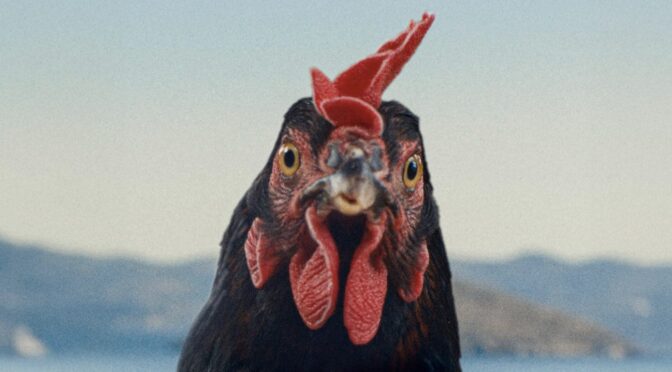
A close-up of a chicken’s pulsating cloaca pushing out an egg – this is the opening of György Pálfi’s HEN. Get used to it, because this is not the last time this film stares down the barrel of its star.
Riding in the wake of FLOW (2024), HEN is a fictional adventure movie with a real, bona fide, non-verbal chicken as its star. After the opening birth scene, HEN’s titular character is unceremoniously shipped out on a truck from her life in a factory farm. At a pit stop, she hops out of her ride to hang with some pigeons buffeting near a garbage pile when her human minder, ignorant of her absence, drives off without her. The hen is caught up in a series of misadventures as she drifts in and out of pockets of the human world. She wanders into a clash between protestors and riot police, she is buried in corn; all in search of a peaceful place to raise her chicks. That’s all there is to it, although HEN does serve as an exhaustive list of possible scenarios that an excessively curious chicken could wind up in.
Despite this, the hen is wildly expressive, which may largely be thanks to the animating heft of Giorgos Karvelas’s cinematography. Goofy subject matter notwithstanding, even shots of the hen’s trepidatious ascent up a staircase weave strange drama into what is, objectively, a bird-brained premise.
“Goofy subject matter notwithstanding, even shots of the hen’s trepidatious ascent up a staircase weave strange drama into what is, objectively, a bird-brained premise.”
Eight different chickens played the leading role, a fact that will alarm long-time fans of fictional adventures starring real animals under duress. Why were so many chickens’ services required? Is HEN repeating what has long been speculated to be the serial tragedies of THE ADVENTURES OF MILO AND OTIS, which is surrounded by a sinister mist of rumours that nearly two dozen real cats died to achieve some of its signature shots? Macabre mysteries like this simmer beneath the surface of scenes in HEN where a real fox seems to be smoked by car traffic, or when the hen is on fire and flutters out of a burning vehicle (maybe not really aflame, but certainly limping and stressed. Cursory searches online reveal nothing of the fate of the eight chickens).
Comparisons to Andrea Arnold’s COW are inevitable, although they are unfortunately to HEN’s detriment. Both begin in the same fashion: a non-human animal gives birth and is separated from her offspring almost immediately. The former is a harrowing map of a life within the vicious architecture of animal agriculture. COW is so sympathetic to its subject, so attuned to her suffering, that its equivalent of the full-frontal birth scene is a moment of heartbreak for its inscrutable subject.
In contrast and despite the way HEN is trumpeted, almost breathlessly, as a touching exploration of the casualties of anthropocentrism, the end product is a blithe (and at worst cynical) contemplation on what a day-in-the-life of a chicken would look like that plunges to the shallow depths of a shower thought. What if a chicken saw a T. rex on a TV? What if she watched humans cook eggs? Once the viewer has clued into the fact that these are real chickens on screen, every one of the hen’s hijinks are punctuated with the film’s own grotesque failure to adhere to its premise. If any of these chickens died for the production of HEN, the situation seems akin to monologuing on the sacredness of life while boxing sheep. Who is the joke really on, here?
“…the end product is a blithe (and at worst cynical) contemplation on what a day-in-the-life of a chicken would look like that plunges to the shallow depths of a shower thought.”
The film’s silliness can register in multiple ways: on one hand, it might be that HEN doesn’t seem to seriously buy into the interiority of its avian subjects, if it even buys into their suffering at human hands. It’s hard to access the inner world of a subject who the audience has been introduced to innards-first. On the other, perhaps the filmmakers felt some type of cynicism towards human-on-human violence and thought it would be funny to explore that in the periphery while throwing chickens into cages full of six aggressively horny free-range roosters. Exactly how can we assess whether the film has failed or succeeded to follow its premise (cloaca, factory farm) to its conclusion (animals should be free)?
There is a moment in the first twenty minutes of the film when the hen is caught between riot police and demonstrators. The hen experiences human politics as the frivolously arbitrary domain of a bigger world laid thoughtlessly atop that of the innocent non-human. A film that is ostensibly meant to sway its human viewers to the interests of the non-human wades into fascinatingly contradictory waters when it dismisses, whole cloth, the struggles, suffering, and interiority of one of the most preponderant animals in its frame: humans.
What is normally an easy tee-up to turn a mirror toward the audience and force introspection just enables the viewer to take comfort that, although they may not have yet gone vegan, at least they’ve likely never chucked a living chicken off the roof of a building for their art.