
The ‘liminal space’ trend was never a truly new phenomenon. A post-pandemic acceleration of internet culture foregrounded a longstanding fascination with unusual spaces. That ephemeral feeling of danger as you walk down an abandoned corridor or through an eerie public space is well-established in pop culture.
Internet-derived obsession with such spaces has now come full circle, expressing itself through influence on video games, as well as television and films such as Severance and the forthcoming BACKROOMS. EXIT 8, an adaptation of a 2023 video game, proves an effective, if stretched, contribution to its cinematic re-emergence.
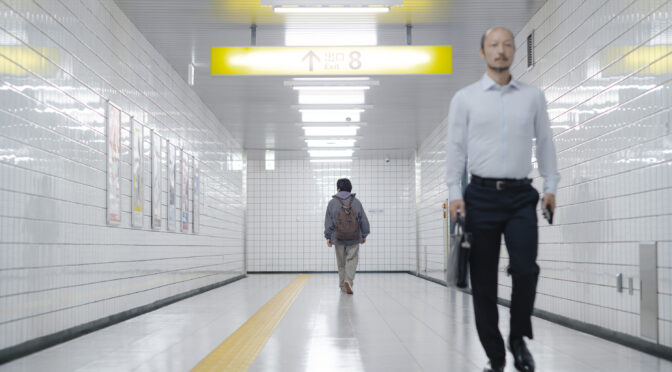
The protagonist, known only as The Lost Man (Kazunari Ninomiya), is introduced to us during what seems like a mundane commute, the train packed with identikit business-casual passengers. After ignoring an irate commuter shouting at a mother because her baby is crying, he departs the train into a Japanese metro station. A phone call from his ex-girlfriend delivers the news she is pregnant, and that she wants him to join her at the hospital. As he navigates the station, he finds himself caught in an endless loop, turning a corner into the same stretch of corridor again and again. The corridor is oppressively sparse, save for a few posters and locked doors, and The Walking Man (Yamato Kochi), who walks down it the same mechanical way (nearly) every time The Lost Man arrives.
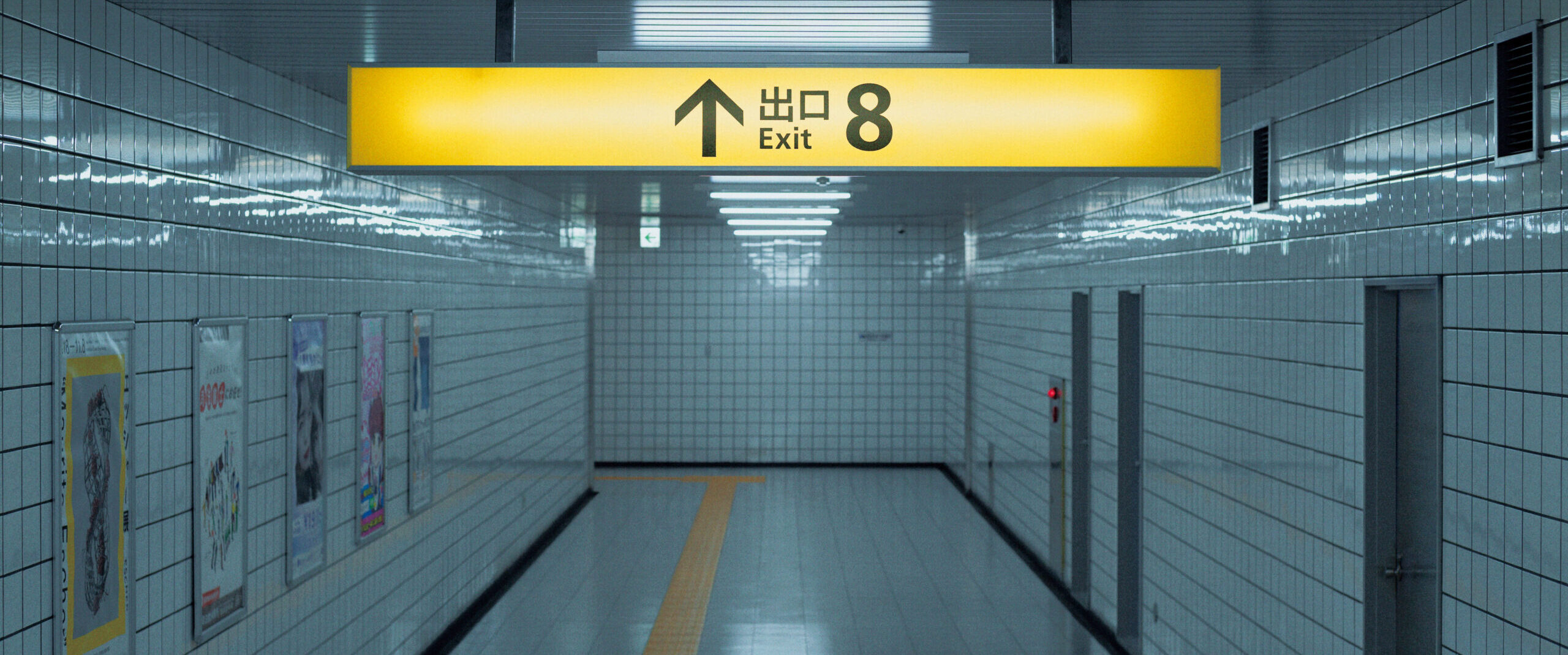
The mechanic adapted from the game requires the player to notice ‘anomalies’; something different in this corridor or out of place compared to its regular appearance. If you notice one, turn back whence you came. If you do not, then proceed down the corridor. Repeat successfully eight times and you arrive at Exit 8. The same process gates The Lost Man’s progress in the film, albeit with an attempt (as there must be) from director Genki Kawamura and his co-writer Kentaro Hirase to attach a character arc to the unsettling and creepy atmosphere.
“EXIT 8 adapts ambience well, […] leaning into the cinematic and artistic influences evident in the original game and the entire ‘liminal spaces’ aesthetic trend.”
EXIT 8 adapts that ambience well, bringing its own creative flourishes, as well as leaning into the cinematic and artistic influences evident in the original game and the entire ‘liminal spaces’ aesthetic trend. There is an explicit reference to Stanley Kubrick’s THE SHINING when water crashes down the corridor in a flood, its muddiness against the aggressively white tiles making it look like the blood that rushes from the Overlook Hotel elevator. The space itself and the sharp corners evoke the corridor Danny Torrance rumbles his tricycle along, the dread building with every turn. Beyond that, the impossibility of the space is connected explicitly to M. C. Escher’s art (a poster in the corridor advertising an exhibition), but also has cinematic lineage in THE SHINING’s unnerving interiors.
In that respect, EXIT 8 creates atmosphere wonderfully: the subtle train door screech repeated each time The Walking Man rounds the corner for the umpteenth time becomes the trigger to brace yourself and tense up. However, The Lost Man still requires thematic motivation for overcoming these challenges. Further, the restrictions imposed by the mechanics require something creatively interesting to keep the film from stalling. EXIT 8 reaches for a captivating storyline to bring together the whole, and is mostly successful, even if it doesn’t quite stretch far enough to fully escape its sterile corridor setting.
“EXIT 8 reaches for a captivating storyline to bring together the whole, and is mostly successful, even if it doesn’t quite stretch far enough to fully escape its sterile corridor setting.”
The film is intrigued by the idea of being numbed by routine, and the idea that change is necessary, but still challenging and scary. The Lost Man begins the film mindlessly scrolling through social media on his phone, in a point-of-view shot that spans the phone call telling him he may become a father. His journey is one of embracing change and taking responsibility, with impending fatherhood the catalyst. The ‘anomalies’ are disquieting, unsettling, and sometimes disturbing. However, it’s only by being present, attentive and facing life’s challenges that he can earn his ticket out into the real world’s shining daylight.
This is a relatable journey to attach to the premise, but the film never quite manages to stop the looping imagery becoming a little stale as the film goes on. An attempt to deepen the themes with a chaptered section focusing on The Walking Man feels like a narrative diversion, more rooted in concern about repetition than storytelling. Linking that chapter to a young boy proves more successful in advancing the film’s themes and The Lost Man’s journey, but some subsequent segments also feel like an inorganic attempt to change the pace. One such sequence veers into trying more overtly scary elements, rather than the subtle off-kilter quality the film’s atmosphere thrives on (even if it calls back to the social media scrolling which opens the film).

“The film is intrigued by the idea of being numbed by routine, and the idea that change is necessary, but still challenging and scary. [Only] by being present, attentive and facing life’s challenges [can The Lost Man] earn his ticket out into the real world’s shining daylight.”
EXIT 8 hits UK screens a few weeks ahead of BACKROOMS, another work based in the modern expression of ‘liminal spaces’ and so-called ‘creepypasta’. Severance has also taken visual inspiration from The Backrooms viral videos. This loop back to modern storytelling via newly evolved forms of community expression is a fascinating circular reference between media cultures. Severance, as a successful TV example, paints compelling characters, dilemmas, and themes atop the spatial oddities, similar to how the likes of THE SHINING, BARTON FINK, or the more recent VIVARIUM did so before in cinema. The best previous expressions of such eerie spaces were in service to a story, and this new wave also needs something beyond an aesthetic idea alone to rise above the original ‘creepypasta’. EXIT 8 just about manages this, but the stretched feeling highlights the challenges inherent in building a film from this particular starting point.
EXIT 8 leans a little too heavily on this aesthetic to remain fully engrossing for even the succinct 95-minute runtime, but the film finds its way much faster than The Lost Man did.