
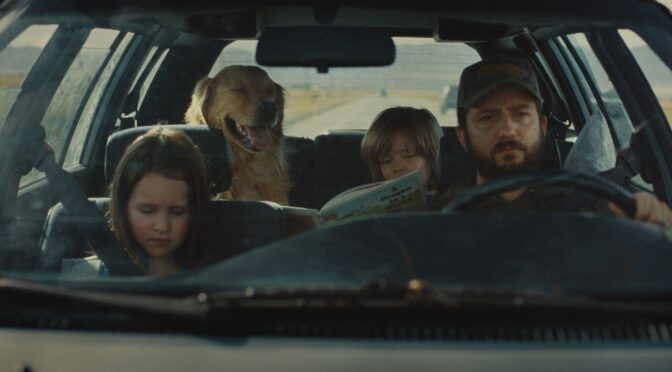
The emotional weight OMAHA craves comes, despite some other inelegant reaches for it, from the performances of the core cast. As a cinematic whole, Cole Webley’s debut feature is perhaps too keen to get bottom lips quivering, and you can sense that eagerness. Fortunately, the empathy generated by young Molly Belle Wright and John Magaro stops the film from cloying.
The film opens with a father (Magaro) sweeping his children into their car early in the morning. His son, Charlie (Wyatt Solis) is still asleep, and he needs to cajole Ella (Belle Wright) out of playfully obtuse stalling to join her younger brother. The urgency with which their father looks to depart is presented as confusing and poorly understood; we hear muffled conversations with a sheriff’s deputy, and see what look like foreclosure papers. They abruptly leave – flee – for Omaha, Nebraska.
Context places the film in 2008, and the precariousness the financial crash perpetuated globally is a spectre throughout the film. There’s clearly a catalyst for the father’s behaviour there, but it’s not spelled out. Instead, Paul Meyers’ photography has a slightly bleached look of an old photograph, and the impressionist sequences of the children playing with kites and the family dog complete the mood of witnessing a childhood memory. However, it’s punctuated with moments of financial reality: Dad can only afford one kite, he drives for blocks to find free parking before going to the zoo, and has insufficient food stamps during a supermarket visit.
It’s a shame OMAHA doesn’t manage to match the narrative dexterity of its actors. The film’s story is at its most impactful when experienced in the way Ella and Charlie do: glimpses of truth, and the knowledge of something being ‘off’, but not understanding. The film isn’t consistent, though, and can’t decide whether to stick with this viewpoint or broaden its focus.
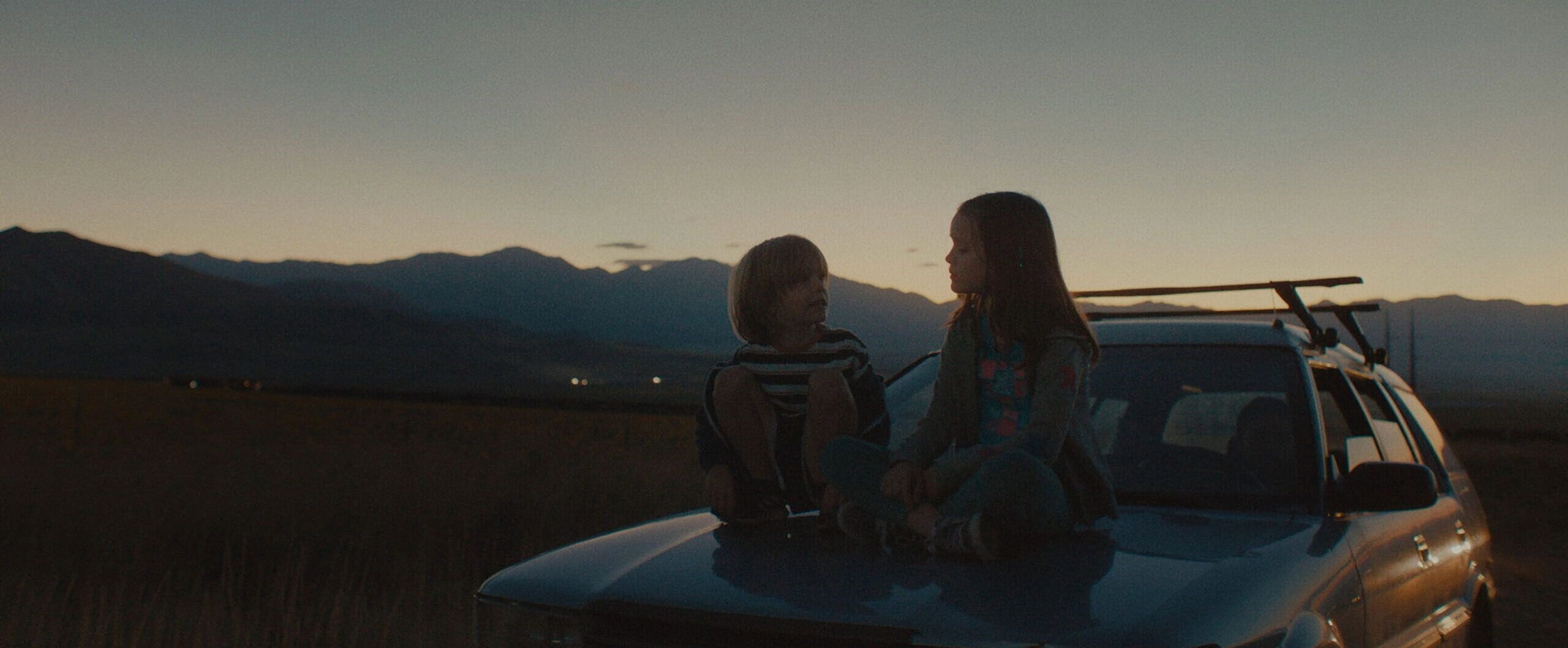
“The film’s story is at its most impactful when experienced in the way Ella and Charlie, [but] the film isn’t consistent […] and can’t decide whether to stick with this viewpoint or broaden its focus.”
Outside dialogue scenes, many link segments and establishing shots linger visually on the scale of the US interior. The film wants to get across the breadth of suffering, and foregrounds the vastness of the US ‘flyover country’, as if to hint at the forgotten financial suffering therein. In this respect, the film unwisely chases breadth when the tools to create compelling depth were offered by the cast right in front of its lens.
OMAHA doesn’t put enormous energy into building these characters into much beyond vessels for hardship, but the two leading performances allow it to skip over the lack of depth. John Magaro elevates his material: the pain evident across his face is palpable, and captures some of the hardest emotions experienced as a parent. Magaro captures the desire and responsibility to make children’s lives great, balanced with preparing them for a world beyond their parents, and the absolute crushing disappointment felt when failing at either for even a second.
“…the film unwisely chases breadth when the tools to create compelling depth were offered by the cast right in front of its lens.”
However, even Magaro’s affecting role plays second fiddle to Molly Belle Wright as Ella, who develops a blend of childishness, pain, and misplaced guilt as her character’s journey progresses. Scenes where Ella places guilt in herself for what is happening are heartbreaking. Even if Cole Webley proves a little heavy-handed in grasping for the emotional beats, he also deserves credit for enabling Wright’s performance and giving it the attention it deserves.
A title-carded coda brings some real-world context to the film’s events. Whilst it provides a final gut punch, it also highlights how the film is more interested in emotional payoff than character, story, and thematic investment to build to a greater one. Magaro and Wright bail out the film in this regard, with their performances too emotionally big to fail.
OMAHA might not employ the most thoroughly crafted methods by grabbing the heartstrings in its fist, but the cast’s performances capture an honesty, nonetheless, and drive home empathy that is difficult to put aside. And maybe you shouldn’t.