
Michael Jackson is often cited as a contender for the greatest entertainer of all time. That reputation makes the dullness of MICHAEL, as it moonlimps to its vapid conclusion, all the more remarkable. Before that, a few flourishes allow it to bumble through a script and edit that have clearly been scrubbed to sterility with the hagiography brush. However, the final result is a film which is bland at best and cowardly at worst.
The film begins during the emergence of The Jackson 5 in the 1960s under their overbearing and abusive father, Joseph Jackson (Colman Domingo), with the young Michael (Juliano Krue Valdi) the breakout vocalist. The film then accelerates to the adult (but still decidedly childlike) Michael’s record-breaking solo career (portrayed by Jackson’s real nephew, Jafaar Jackson), culminating in a performance at Wembley Stadium in 1988.
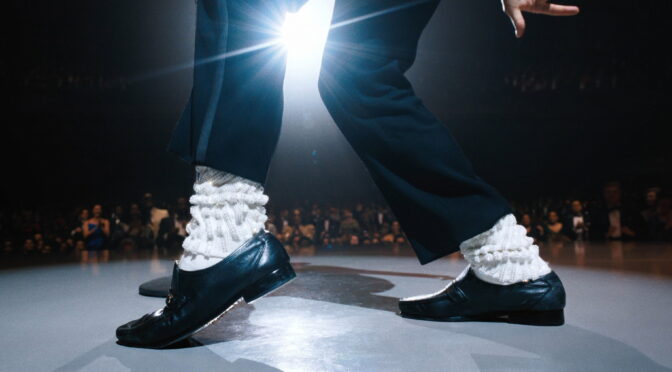
The film will inevitably attract ire with its depiction of Jackson’s life, or, more accurately, what it seems to omit. However, MICHAEL is also an inexplicably boring film, where director Antoine Fuqua can’t muster enough visual verve to deliver anything archival footage of Jackson would not. It’s also a waste of Jafaar Jackson, who captures the electric energy of his uncle’s performances with physical flair. Despite some moments where Fuqua threatens to break the mould, such as focusing on the singer’s physics-defying footwork in close up, it’s barely a nanosecond before the camera reverts to bland pans across the audience. As if branded by the production line of musical biopics, it’s also only a matter of time before a clichéd shot from behind the performer is deployed, with the spotlight literally and metaphorically glaring.
“The film will inevitably attract ire with its depiction of Jackson’s life, or, more accurately, what it seems to omit. However, MICHAEL is also an inexplicably boring film…”
The film’s vapidity is all the more irritating given the allusions and nods it makes to the things that shaped all facets of Jackson’s life, image, and creative vision. The film lingers on his reverence for Charlie Chaplin and Gene Kelly. Jackson is shown watching both on screen with his mother, in a blend of escapism from his abusive father and planting the seeds of his own artistic expression. The singer’s obsession with Peter Pan is connected to his history of plastic surgery, but after some lingering zoom shots is barely mentioned again. His love of animals and the introduction of Bubbles is the clearest expression of the film’s cowardice. The film looks as if it may be gesturing towards the tragedy of his identification of various exotic animals as his only ‘friends’. However, the chimp’s entrance is played as a light, adorable zoological goof, confirming Michael’s innocent loving nature, rather than portraying it as the shriek for help it appears to be.
“The film’s timeline finishing neatly short of the first child abuse allegations in 1993, which dogged the singer for the rest of his life, creates a giant red-leather-clad, fedora-wearing, begloved elephant in the room.”
Michael Jackson’s real story is an undoubtedly fascinating one, but MICHAEL dances around the gnarlier parts of that personal history, from which many have drawn a straight line to the controversies in Jackson’s adult life. The film’s timeline finishing neatly short of the first child abuse allegations in 1993, which dogged the singer for the rest of his life, creates a giant red-leather-clad, fedora-wearing, begloved elephant in the room.
Perhaps these omissions shouldn’t be surprising. The film underwent reshoots because the terms of a legal settlement prevented the depiction of anything related to the Jordan Chandler case. Further, the film is embedded within the Jackson family machine (the credits make it seem easier to find a living Jackson without a producer credit). However, the fingerprints of the film’s determination to beatify its subject still haunt the story. Jackson’s repeated visits to children in hospital would, in a filmmaking sense, read as saccharine and forced in any case. In a world where documentary LEAVING NEVERLAND exists – featuring graphic accusations of Jackson’s alleged sexual activity with children – they also read as a desperate attempt to cinematically side-eye this aspect of Jackson’s public story. It’s the film’s very own antigravity move: it leans towards this part of Jackson’s life, without stepping closer, before returning to its simple upright position.
Even if the film’s shirking of these perspectives is framed as a creative decision to tell a success story, MICHAEL is a dull victory stroll which eventually drifts into a soporific shuffle. For a story of a man hailed as a revolutionary entertainer, it falls short even on its own venerative terms.
Comments are disabled because, frankly, we just do not have the energy.