
There is a neatness to 28 DAYS LATER, Danny Boyle’s seminal 2002 feature that kickstarted a new wave of zombie cinema and television. At the height of the COVID pandemic, nearly twenty years after its release, the combination of simple, striking imagery (like the deserted Westminster Bridge) and a lack of heavy-handed allegories allowed the film to flourish with new meaning. Even if the film had a peculiarly British flavour of paranoia stemming from the war on terror, the tightly-realised concept allowed it to resonate anew. 28 YEARS LATER defies such neatness, and although that is not always for the better, Boyle’s work on Alex Garland’s scattershot script has an engaging blend of sincerity and brutality.
As the title suggests, the film eventually picks up about twenty-eight years after Cillian Murphy wandered across a deserted London. The Rage Virus, which famously rendered ‘the infected’ into ravenous, berserking zombies (a far cry from the classic shufflers), has decimated Britain. The film quickly brushes away the spread to continental Europe depicted in the final frames of the slightly overlooked interstitial entry, 28 WEEKS LATER, to focus squarely on the quarantined UK, “cut off from continental Europe” as an opening scrawl unsubtly puts it.
A flashback to the original outbreak serves as a prologue (much like 28 WEEKS LATER). A young boy, Jim (Rocco Haynes), witnesses the annihilation of his family and neighbours while Teletubbies plays in the background. The juxtaposition is a darkly hilarious sequence, and maybe Boyle’s most strikingly so since some of the flights of fancy in his debut, SHALLOW GRAVE. The boy’s father – a priest – then greeting the onrushing wave of flesh eaters as a sign of the rapture and divine judgment is another disturbing moment. The prologue is an early adrenaline shot before the film shifts down a gear and into the time frame of the title.

“Some degree of a Brexit analogy emerges from the outset, and not only via Britain’s obvious sectioning off from Europe. Holy Island’s fake old-timey nostalgia floats in the air, even more stultifying than the mainland’s stench of death.”
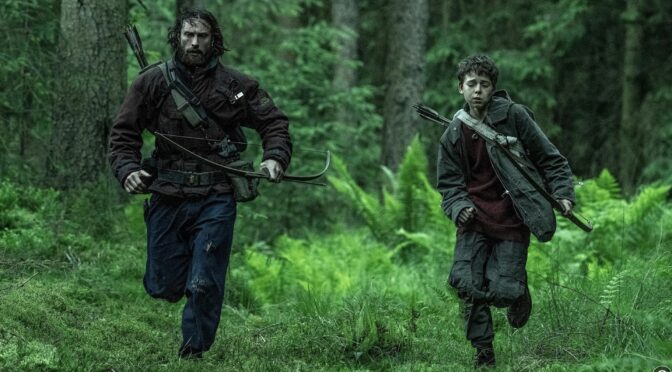
The focus from hereon is an isolated island community – Holy Island – which has carved out an identity and life independent of the ravaged mainland in the intervening decades. Jamie (Aaron Taylor-Johnson) is taking his son, Spike (Alfie Williams), on a ritualistic (and perhaps slightly premature) trip to the mainland with a zombie-killing bow and arrows slung over his shoulder. This masculine rite of passage also allows a further opportunity for Jamie to put his ailing and bedridden mother of his child, Isla (Jodie Comer), at home.
Some degree of a Brexit analogy emerges from the outset, and not only via Britain’s obvious sectioning off from Europe. Holy Island’s fake old-timey nostalgia floats in the air, even more stultifying than the mainland’s stench of death. Tattered – later flaming – St George’s flags ripple in the sea breeze while the islanders reassure themselves of the exceptional nature of what they have built, which they must protect from any incursion from the outside world.
The repeated non-diegetic chanting of Rudyard Kipling’s ‘Boots’ while we see various archive imagery representing English and British wars across the centuries also aids in heightening the unsettling atmosphere (the film’s trailer also used the reading of the poem to great effect). The increasingly frantic repetition (“Boots—boots—boots—boots—movin’ up and down again!”) against images of war stamps home the feeling of Britain being uniquely doomed to repeat insular irritability in different eras.
However, Boyle and Garland’s metaphors are not allowed to be simplistic and one-to-one. There is a clear critique of the islanders’ mentality and lack of curiosity, perhaps most clearly presented in their suspicion of Dr Kelson (Ralph Fiennes), who is brushed aside as mad. The dismissal of a former medical professional also relays a faint echo of the infamous declaration by Michael Gove that “people in this country have had enough of experts”. However, ‘the infected’, cut off from the outside world, also act as an avatar of the aimless anger that has risen in the British Isles. In particular, introducing the concept of an ‘alpha’ zombie puts forward a terrifying and relentless threat in the story, symbolic of a ceaseless and flailing rage that the British public can often impotently possess.

“The repeated non-diegetic chanting of Rudyard Kipling’s ‘Boots’ [and its] increasingly frantic repetition stamps home the feeling of Britain being uniquely doomed to repeat insular irritability in different eras.”
The horror elements develop and release tension in a well-paced manner, but it’s the examination of the self-aggrandising mindset where the film is at its sharpest. As the islanders celebrate the exploits of Jamie and Spike in a community hall, Jamie embellishes his son’s prowess while a boorish crowd of drinkers roar him on. His son’s befuddled questioning undercuts this celebration of made-up accomplishments. In that sense, it shares some themes with a scene in Boyle’s only other sequel in his filmography: T2 TRAINSPOTTING. Sectarian fools are mocked in that film, singing and chanting bigoted views of supposed past glories in a boozy social club or Orange Lodge; it’s a sad facade in front of a miserable existence, not unlike Holy Island here. The community lives on inflated stories of its grandeur. It is beholden to rules meant to embody stoicism and responsibility, which simply enforce artificial civility (neatly and intimately undercut by Jamie’s infidelity and chauvinist sense of fatherhood).
Just when the film seems to run out of ammo, the presence of Ralph Fiennes places a new arrow in the film’s quiver. His character embodies a calm, humanity and compassion absent – or at least tamped down – in the Holy Island residents. He represents a more optimistic view of human behaviour in crises. The mindset offered embraces death as an opportunity for continuing celebration of the lives that were, not for raging against the dying of the light. The film’s stamina eventually wanes (this dense bag of ideas somehow manages to touch upon assisted dying in the final stretch as well). A pseudo-epilogue also abruptly ends by introducing a goofy and singularly British manifestation of spiritual ugliness that presumably serves as a confusing segue into the confirmed 2026 sequel, 28 YEARS LATER: THE BONE TEMPLE.

“…in defying a desire for simplistic metaphors and clear avatars for contemporary concerns, it’s arguable that 28 YEARS LATER allows meaning to emerge in the minds of individual viewers in more complex and unexpected ways.”
These themes careening around the verdant pastures of Boyle’s post-apocalyptic England don’t have a lot of room to breathe and develop. There is a sense that Boyle and Garland have myriad ways they may have wanted to progress and update their original story and world, and have attempted nearly all of them. In that sense, they do not express any single one especially clearly. However, in defying a desire for simplistic metaphors and clear avatars for contemporary concerns, it’s arguable that 28 YEARS LATER allows meaning to emerge in the minds of individual viewers in more complex and unexpected ways. Those who attune themselves to one of the film’s various frequencies will connect with it; those who do not will only perceive muddled static. 28 DAYS LATER always had deeper comments about the veneer of safety and institutional order hanging off the scaffolding of its visceral action rush and technical filmmaking risk, but 28 YEARS LATER seems to flip that. The established style and iconography of the original provide the foundation for Boyle and Garland to express their more allegorical ideas.
For a film coloured so heavily by Brexit and Britain’s reduced place in the world (pity poor Ireland, seemingly damned by association here), there is something deeply observant in using Rudyard Kipling’s poetry to establish an unsettling tone. Somewhat jingoistic UK sports coverage – usually luxuriating in the surroundings of the All England Tennis Club – frequently uses Kipling’s ‘If–’. There, the author implores someone to “[become] a Man, my son!” by displaying various virtues, including “if you can meet with Triumph and Disaster, and treat those two impostors just the same”. 28 YEARS LATER makes bold and sometimes confusing choices. They may not be disastrous, but they certainly aren’t always triumphant. Given the expectations many may have of a 28 DAYS LATER sequel, the fact that Boyle and Garland choose to “trust yourself when all men doubt you” is a cinematic virtue in and of itself.