
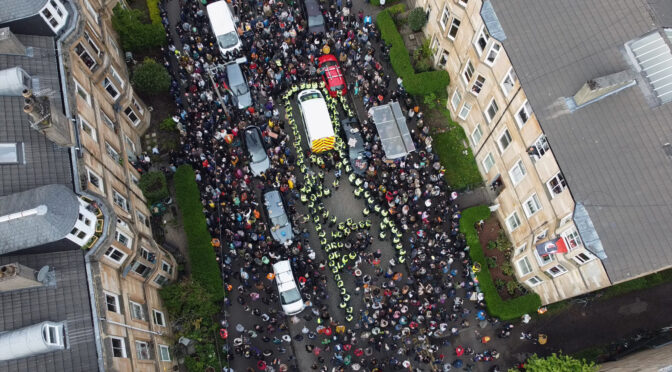
 On May 13th 2021, immigration enforcement officers came to Kenmure Street in Glasgow and detained two men. Within minutes, neighbours came out and surrounded the van, setting the stage for a day of protest and community solidarity that is lovingly documented in EVERYBODY TO KENMURE STREET. Felipe Bustos Sierra’s latest documentary is a fitting one to open Glasgow Film Festival 2026 as a thoughtful exploration of Glasgow’s political history and how a community can come together to make a political difference.
After a brief montage of Glasgow history through film and newsreel clips, the film settles into a traditional documentary mode to show the events of the Kenmure Street protest: talking heads discussing first seeing the immigration enforcement van arriving; drone footage of the street and the local geography of Pollokshields; shaky mobile phone footage from the actual event. The recorded footage that Bustos Sierra relies on to stitch together the narrative is crucial, and not only as a primary historical text. The imagery is also deeply resonant of the phone camera footage of ongoing atrocities that we’re all too used to seeing, most recently out of Minnesota.
“While the footage of the huge crowd that gathered that day shows that Kenmure Street was a collective action, the film uses various techniques to emphasise that the collective is always made up of individuals.”
While the footage of the huge crowd that gathered that day shows that Kenmure Street was a collective action, the film uses various techniques to emphasise that the collective is always made up of individuals. The narrative focuses on people like the man who immediately crawled under the van to stop it from leaving, the human rights campaigner who rallied the community, the nurse who looked after the man under the van all day, and the solicitor who negotiated with Police Scotland. Some of these people don’t appear on camera – the van man and the nurse – but instead have their words read by actors, Emma Thompson and Kate Dickie respectively, which further emphasises the personal aspect of this political action. We’re continually reminded that a city, a community, is a bunch of individuals.
This is contrasted with the absence of any kind of voice from the other side of the story. Bustos Sierra does not include interviews with the Home Office, Police Scotland, the officers who were there that day, or the Westminster Tory Government whose policies allowed for dawn raids. We don’t hear from them so that they appear as they did to the victims of that day and the community who came together: as the faceless avatars of state violence.
“We don’t hear from [authorities] so that they appear as they did to the victims of that day and the community who came together: as the faceless avatars of state violence.”
Though viewers (especially at Glasgow Film Festival) may already be familiar with the story of the Kenmure Street protest, EVERYBODY TO KENMURE STREET provides meaningful context and details. Multiple interviewees discuss the clear provocation of launching a dawn raid on the first morning of Eid al-Fitr, one of the holiest days in the Muslim calendar, in one of the most diverse communities in Scotland. We hear about the bus stop near the van being turned into a food and water station, and the nearby mosque opening its doors so police and protestors could use the toilets. These smaller “act[s] of care around the broader act of care” show the power of community organising, especially against the background of the police’s failure of community policing.
Felipe Bustos Sierra previously directed NAE PASARAN, covering Scottish workers’ solidarity with the people of Chile under Pinochet’s dictatorship. Sierra’s clear understanding of Scotland’s historical and political context come through as he positions Kenmure Street as more than an isolated event. From the opening montage showing Glasgow’s shipbuilding, manufacturing, and history of political protest – from Red Clydeside and Jimmy Reid to antinuclear demonstrations, anti-apartheid actions, and trade unionists standing up to Margaret Thatcher – the film positions the events of that day as deeply enmeshed in the radical history of the city. However, Bustos Sierra appreciates the complexities of Glasgow’s position as interviewees discuss how the city benefited from the plantation economy, the slave trade, and centrality within the imperial core. Without leaning into Scottish exceptionalism, the film also emphasises the Scottishness of what happened that day by laying out how immigration is a power reserved by Westminster and how the Tory Government and the Home Office left Police Scotland to enforce their racist policies. It’s notable that at the end of the day, it was Police Scotland who made the decision to release the two men, not the Home Office.
As the men were freed, human rights campaigner Mohammad Asif told the crowd that “this teaches the lesson to the rest of the United Kingdom that the people of Scotland should not be messed with”. Though the film does this as well, it also reaches for a broader point: that the faceless avatars of state violence who abduct people off the streets cannot stop people coming together as a community. At its heart, EVERYBODY TO KENMURE STREET is about a lot of individuals who all made the choice to help, to look out for their neighbours, and to protect two men. It emphasises the personal and the charming bunch of people who came together that day to show that the personal is the political and the local is the global. As the city’s slogan says, People Make Glasgow.