
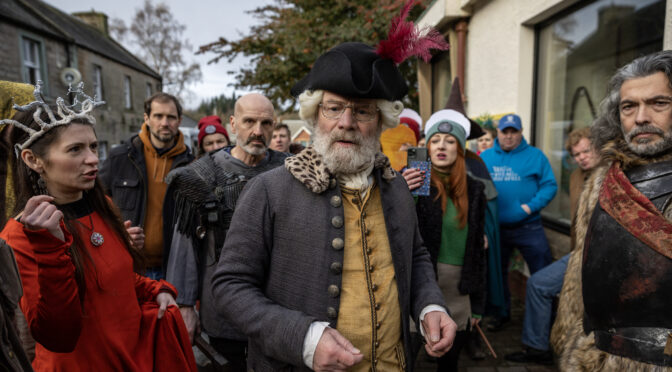
 THE FALL OF SIR DOUGLAS WEATHERFORD is deeply embedded in a Scottish context. The story of a tour guide in a small Borders town, driven mad by the intrusion of a television crew filming a prestige fantasy series really speaks to the impact of the Scottish tourist industry on local communities. The film balances a light comedy tone with unexpected poignancy, even if some of its more impactful ideas are underdeveloped.
Kenneth (Peter Mullan) is a tour guide for the Arberloch Visitor Centre, a dusty local attraction in a town whose main claim to fame is the forgotten Enlightenment-era natural philosopher, Sir Douglas Weatherford. When the crew for a fantasy series, The White Stag of Emberfell, descend on the town for an extended period of filming, Kenneth’s life is disrupted by cosplayers crowding the streets. Fans of the books take over his tours, and the visitor centre being transformed into a shrine to the show. Sir Douglas Weatherford’s legacy is more forgotten than ever as Arberloch contorts itself into a new shape imposed by the tourist industry.
THE FALL OF SIR DOUGLAS WEATHERFORD is the debut feature film from writer and director Seán Dunn, whose family history in Scotland shines through in the specifically Scottish context of the film. In a Q&A at the UK premiere as part of Glasgow Film Festival, Dunn spoke about how he’d been inspired by wandering around Edinburgh and seeing a crowd of Harry Potter tourists taking photos in front of graves in Greyfriars Kirkyard. The fictional fantasy show in the film bears more than a passing resemblance to Game of Thrones and to a lesser extent Outlander, both of which have filmed in Scotland and left their mark through the tourist industry. This TV tourism is part of a long lineage of Scotland being treated as a theme park by tourists from across the world, going back to the romanticized Victorian idea of the Highlands, which turned vast areas into closed-off playgrounds for the wealthy. The film asks what the impact is for local communities when tourists take over a town. What is lost when a local economy pivots towards chasing the tourist pound? Is there some bedrock of reality ignored when a fictional series overwrites local history?
“This TV tourism is part of a long lineage of Scotland being treated as a theme park by tourists from across the world, going back to the romanticized Victorian idea of the Highlands, which turned vast areas into closed-off playgrounds for the wealthy.”
The soundtrack by Gazelle Twin further taps into these ideas of a rural Britain hollowed out by modern industry. Gazelle Twin has form for exploring these ideas through her music, most notably in Deep England, her 2021 collaboration with NYX. Her distorted electronic sound tinged with a hint of traditional folk music verging into folk horror provides an appropriate sonic background to the film’s narrative. Some of the film’s most electrifying sequences pair Gazelle Twin’s soundscape with VHS-style visuals and the different framing of these scenes works well to visually represent Kenneth’s descent into madness.
“The soundtrack by Gazelle Twin further taps into these ideas of a rural Britain hollowed out by modern industry. Her distorted electronic sound tinged with a hint of traditional folk music verging into folk horror provides an appropriate sonic background…”
Peter Mullan delivers a great performance as the put-upon tour guide losing the connection that he has to local history. He brings a sense of light comedy to Kenneth’s plight – a tone recently seen from Mullan in another Scottish film, I SWEAR – but also a depth of sadness and poignancy in a character who recently lost his wife and feels abandoned by his daughter (Gayle Rankin). Mullan’s casting has come to feel slightly ironic given the recent announcement of his role in the Game of Thrones spin-off, A Knight of the Seven Kingdoms, thus becoming the kind of actor who would annoy Kenneth in the film. Kenneth also develops a rapport with a young camera operator (Lewis MacDougall) who seems more interested in filming birds than filming Kenneth’s local history lectures: their relationship is an interesting though sadly underdeveloped part of the film and pays off with an emotional climax that could have been better executed.
Though the central narrative around Kenneth, a man left behind by ageing and the society around him, reaches a poignant conclusion, other elements of the film needed more attention. The allusions to Scotland’s colonial history through implications of Sir Douglas Weatherford’s past acts are welcome but underserved. Similarly in the Q&A, Dunn tied the idea of being replaced to recent discussions about “AI” and labour and though there are elements of that idea that come through, the observations aren’t sharp enough to land effectively.