
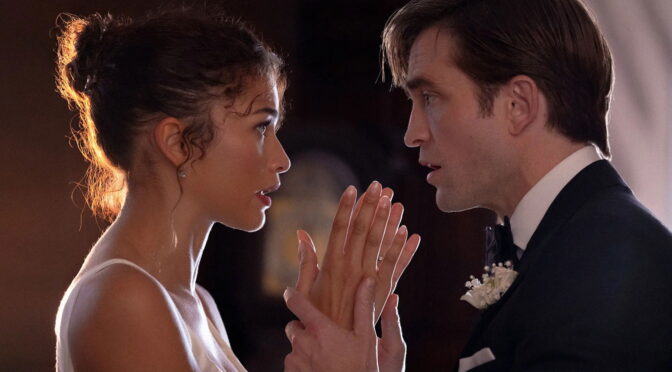
Cinema has the power to be a provocative medium, but the execution can sometimes create a binary of either solemn intellectualism or needless controversy. Kristoffer Borgli’s newest feature, THE DRAMA, is both fiendishly juvenile and thought-provoking, with a signature black comedy approach that harmonises these two qualities.
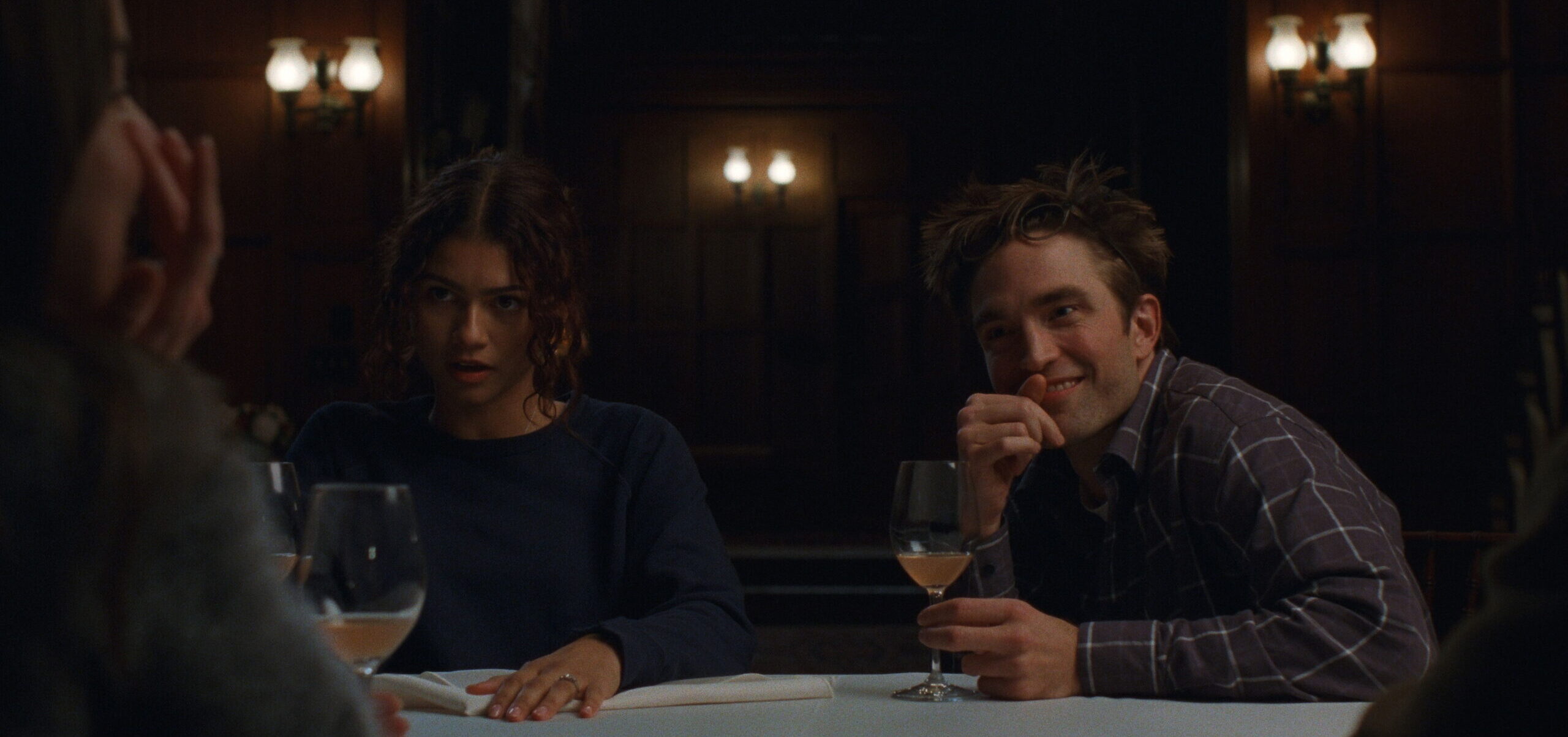
The film focuses on (apparently) happy couple Emma (Zendaya) and Charlie (Robert Pattinson), opening with the latter drafting his speech for their upcoming wedding. From the off, THE DRAMA prods at the edges of what we deem acceptable, with Charlie recounting his initial flirtations with Emma, while the film’s visual approach heightens the slightly stalker-y nature of it. When the couple end up discussing “the worst thing you’ve ever done” with their best man, Mike (Mamoudou Athie), and maid of honour, Rachel (Alana Haim), over dinner, Emma’s revelation spirals the group off into shock, recrimination, existential crises, and Rachel disowning Emma.
The exact nature of Emma’s revelation, despite the many flashbacks and brief vignettes depicting related moments in her past, is secondary to how the characters react to it, including herself. Although the topic is almost certain to garner a certain amount of po-faced indignation in the United States, the specifics can remain opaque in this discussion, as they are secondary to the film’s moral arguments. In establishing the film’s thesis, it’s more notable Emma reveals something she (still quite abhorrently) considered doing, but subsequently did not. That contrast of reality and perception, across a group of people but also within an individual, echoes Borgli’s previous work.
“THE DRAMA is less obsessed with the specific confession than it is the characters’ overreactions, underreactions, and hypocrisies similar to those depicted in Borgli’s prior two films.”
Borgli’s latest film is fascinated with where we seemingly draw lines with the people in our lives. His previous work offers hints as to what THE DRAMA is more interested in than the specifics of Emma’s disclosure: where we place moral limits, and how we hypocritically overstep them ourselves. SICK OF MYSELF posits modern social-media-fed narcissism as a sickness, brought to literal manifest in its protagonist’s descent into self-induced illness for attention. That vice is contrasted against the more ‘worthy’, yet no less obnoxious, self-obsession of her artist boyfriend. DREAM SCENARIO positions Nicolas Cage’s professor as a benign and passive entity greeted with patronising warmth, before a context flip, but not his actual behaviour, changes that perception to one of a threat. THE DRAMA is less obsessed with the specific confession than it is the characters’ overreactions, underreactions, and hypocrisies similar to those depicted in Borgli’s prior two films.
The things which THE DRAMA pokes at the most with Emma’s story are rooted in how she is seen to have developed as a character prior to us (or, indeed, Charlie) meeting her. Does Charlie need to love who she was, or just who she is? What about whom she will become? In the context of the film’s themes, Charlie’s spiralling questioning in the film is not a literal interrogation of Emma’s past, but of whether he can – or even should – reconcile two images of her. In turn, how does his process there affect how he might do so with the myriad possible ones after they marry? It’s notable that his reaction to a hypothetical act by Emma precipitates multiple actions from him which are naive at best and breaches of trust at worst, yet he does not face the same opprobrium. The same hypocrisy can be levelled at Rachel, who has the most emotionally condemnatory reaction to Emma, but only escaped the consequences of her confessed indiscretion more by luck than choice.
In fact, the inciting incident for the conversation where Emma spills her secrets gestures at how we decide when to judge people. The couple discuss firing their DJ because they saw her doing drugs in the open. Had the couple not seen her, they would never have thought of it, so should they now?
“The film renders philosophical thought experiments as tangible personal relationships. The famous question ‘If a tree falls in a forest and no one is around to hear it, does it make a sound?’ is inverted here.”
The film renders philosophical thought experiments as tangible personal relationships. The famous question ‘If a tree falls in a forest and no one is around to hear it, does it make a sound?’ is inverted here. The ramifications of Emma’s unrealised actions have no existence outside the subjective reaction they produce in those who know about them, and the film asks whether that permits an objective moral verdict. THE DRAMA doesn’t offer a simple judgment against the quieter yet fully enacted transgressions of those around her. Instead, the spiralling macabre farce that follows reveals a film more interested in what happens when we try to reconcile unfulfilled intention with moral reality.
This clash of perception and reality – also explored in DREAM SCENARIO – is even brought somewhat clumsily to the surface in more than one character interaction. When Charlie is point-blank asked whether he loves Emma or his idea of Emma, Borgli’s script explicitly states that clash. Yet the film is already on a path that ends in the realisation that friendship and companionship begin with a fixed idea. They only persist with a constant renewal of that choice.
“When Borgli thumbs his nose at testy topics like this, there is an undeniably juvenile dimension. However, the film’s willingness to pursue that tonal balance in service of scratching the surface of twisty moral dilemmas and philosophical quandaries is engaging.”
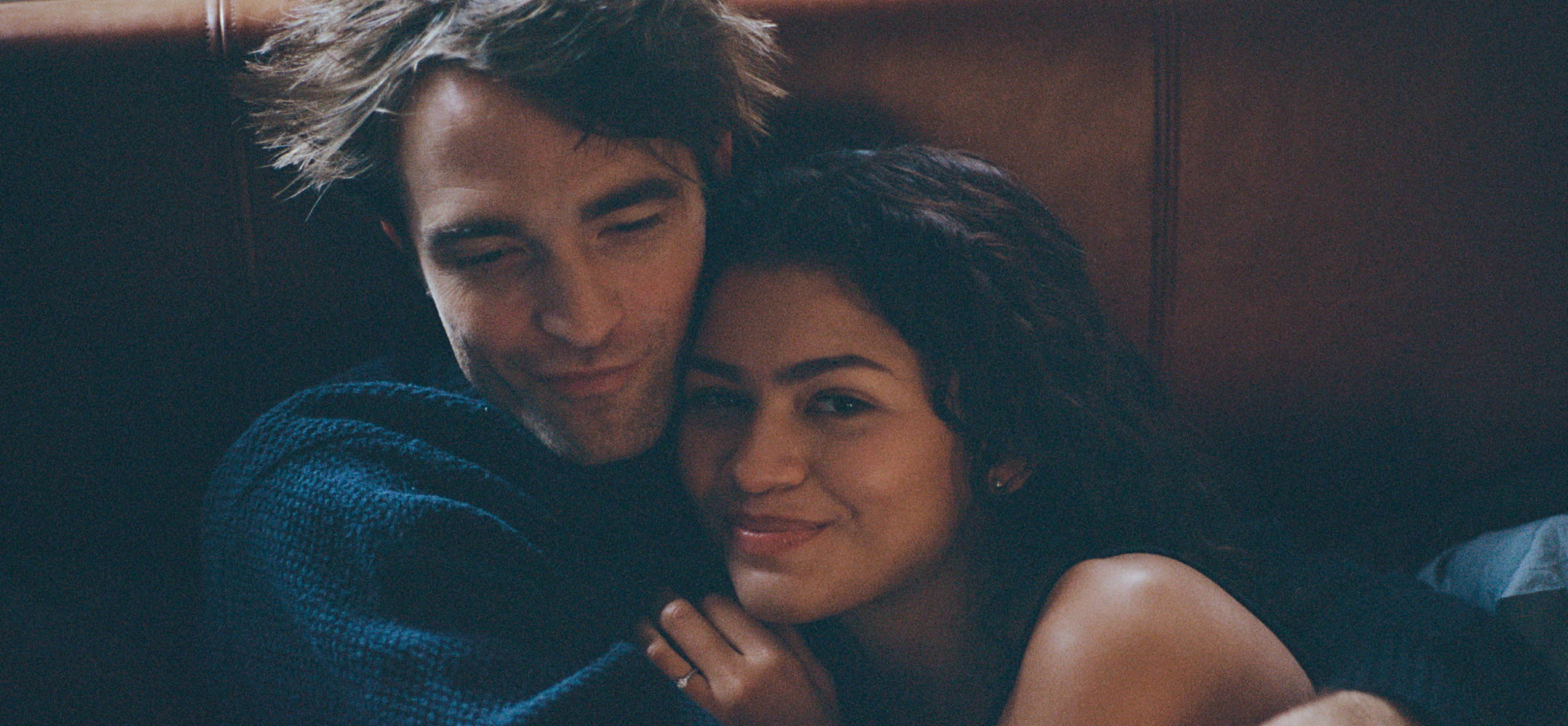
The film approaches its topics with a wry and edgy sense of humour which completes a unique blend for which Borgli is responsible as writer-director, a clear echo of SICK OF MYSELF and DREAM SCENARIO. There are frequent flashbacks to Emma’s past, where we see her dark ruminations interfered with by banal computer trouble and a childish clumsiness. When Borgli thumbs his nose at testy topics like this, there is an undeniably juvenile dimension. However, the film’s willingness to pursue that tonal balance in service of scratching the surface of twisty moral dilemmas and philosophical quandaries is engaging. Borgli’s penchant for provocation has been compared to Lars Von Trier’s confrontational tone, and his awkward humour with Ruben Östlund’s eccentric satires. However, there’s a hint of FOUR LIONS and Chris Morris’s work in many segments, where a comic absurdity undermines the gravity of a hot-button topic at all turns, yet the import, in turn, renders the farce slightly tragic.
Arseni Khachaturan’s cinematography on 35 mm gives the film a grainier look, which feels thematically apt when considering ideas which lack sharp metaphorical lines. More importantly, though, Borgli frames and blocks his cast effectively, and co-editor Joshua Raymond Lee paces it appropriately throughout. The film slows when discomfort and awkwardness needs to be felt, and rapidly cuts when the chaos accelerates. The framing and blocking of characters emphasises their emotional or mental state; during the pivotal dinner conversation, there are many combinations of the four participants in and out of frame, and their relative position when within sight define the scene’s rising awkwardness despite the static physical setup.
At one point, an irascible dance instructor impatiently opines to the couple that weddings “are performative by nature”. It’s a moment which almost reveals a twisted metatext, with the sound of awkward laughter greeting every contortion. The entire cinematic construct of THE DRAMA, including, perhaps, our own reactions as an audience and what we perceive the film to be, is performative by nature.