
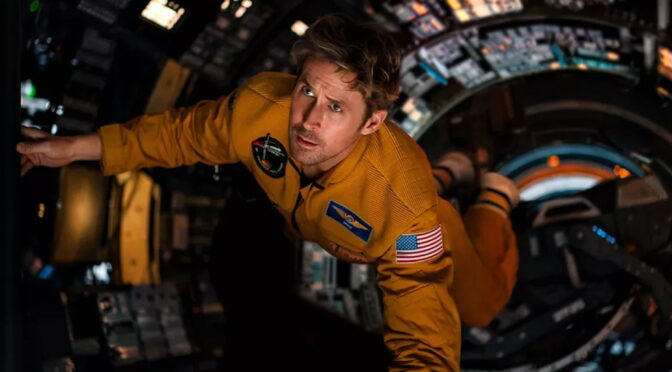
While the ‘hard science fiction’ category of literature prizes scientific accuracy, the most resonant themes of its best cinematic adaptations or cousins lie outside factual detail. The moral, philosophical, and emotional questions of humanity are what reach beyond the screen. PROJECT HAIL MARY evokes many forebears which have perhaps examined such themes more deeply or to better effect. However, even if it remains emotionally simple (sometimes stubbornly so), few films can offer as many shining moments.
Phil Lord and Christopher Miller direct from a script written by Drew Goddard, the latter’s second adaptation of an Andy Weir novel after Ridley Scott’s THE MARTIAN. Ryan Gosling leads as Ryland Grace. When we meet Grace, he wakes on a spaceship distant from Earth, with no memory of how he got there. The film flits back and forth between his current situation and the past. We learn he was a high school science teacher called upon by the authorities to investigate a microscopic ‘astrophage’. The organism is responsible for consuming energy from and dimming not only Earth’s Sun, but nearby stars as well, except for one: Tau Ceti. When his ship arrives at Tau Ceti to investigate that star’s resistance, an alien ship arrives shortly after with the same purpose.
“Gosling’s performance is the primary catalyst for gelling PROJECT HAIL MARY’s grave situation with its lighter approach.”
PROJECT HAIL MARY owes much to Ryan Gosling in developing a tone that is difficult to achieve: he embodies the playful, often humorous approach to averting the apocalypse. Gosling’s noted (but somehow still underappreciated) knack for physical comedy and exasperated line deliveries pays dividends, much like Matt Damon’s sarcastic resilience did in THE MARTIAN. The film has little interest in despair or desperation. It is a much more optimistic assessment of human behaviour in the face of impending doom than Danny Boyle’s SUNSHINE, for instance, which deals with the same plot issue of a dying Sun against darker challenges. ANIARA has the same stranded-in-space setting, but extrapolates humanity into a bleaker future. Gosling’s performance is the primary catalyst for gelling PROJECT HAIL MARY’s grave situation with its lighter approach.

Weir’s novel dates from 2021, and without projecting contemporary geopolitics too strongly onto fictional work, it’s hard to ignore some echoes and contrasts. The challenge Grace faces is effectively a conceptual inversion of climate change. Further, he only makes serious progress when joining forces with ‘Rocky’, the rock-like alien with whom he bonds. International co-operation put Grace in deep space, yet common ground with an entity supposedly unlike him in every way is the seed of success. The story takes plenty of liberties with how easily Grace and Rocky establish communication, with a fundamental hurdle barely registering. However, the ease with which two wildly different beings cooperate and bond is part of the story, as well as the societal and emotional benefits of them doing so. The easy removal of this barrier is emblematic of the film’s charms and limitations; it has a clear emotional endpoint in mind, but perhaps dismisses some meaty ideas in favour of reaching it.
“The easy removal of [a key] barrier is emblematic of the film’s charms and limitations; it has a clear emotional endpoint in mind, but perhaps dismisses some meaty ideas in favour of reaching it.”
Despite the central bond being engaging, the film’s most interesting segments are in the Earth-bound flashbacks. If Gosling is the burning star around which the film revolves, then Sandra Hüller’s performance as Eva Stratt is the dark matter keeping it in a stable orbit. Her more reserved performance brings some seriousness to the situation, and the German actor’s skill in combining intensity and deadpan delivery establishes stakes beyond the extraterrestrial odd-couple drifting around Tau Ceti. Stratt’s relationship with Grace also adds a rougher texture to the film’s understanding of duty and cooperation, which would run the risk of being slightly twee and flippant if Grace and Rocky were the only dynamic examined. Scenes where Stratt flexes away from her unperturbed demeanour are the film’s most intriguing character moments.

“If Gosling is the burning star around which the film revolves, then Sandra Hüller’s performance as Eva Stratt is the dark matter keeping it in a stable orbit.”
There is a yearning optimism which is very keen to telegraph its emotional waypoints. Yet, when combined with the humorous flippancy Lord and Miller specialise in (the overall tenor will be familiar to those who watched 21 JUMP STREET or THE LEGO MOVIE), the film often feels like it is unwilling to commit to its heavier moments. The film’s aggressive pursuit of light-heartedness isn’t to the exclusion of all facets of the tale, but the survival of others feels attached to Hüller’s performance. Even then, the complexity Stratt adds to both the themes and Grace’s character journey deserved more attention, and to be developed as a thematic rounding out rather than mere narrative inflection point.
The successful combination of Gosling’s charisma, Hüller’s acting skill, and the scientific wit of Weir shouldn’t be considered a total surprise; it creates a similar burst of energy to that of THE MARTIAN. Although it’s possible PROJECT HAIL MARY doesn’t have quite the gravitas some of the story’s darker and more philosophical corners offer, its constellation of stars remains resolutely undimmed.