
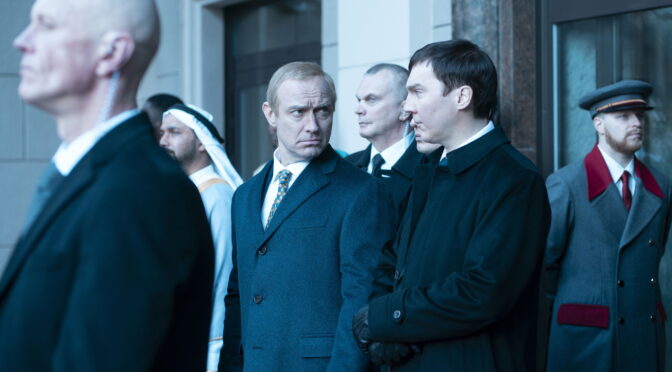
There is so much verbiage in THE WIZARD OF THE KREMLIN, it feels as if it’s attempting a complex incantation. Although Jude Law’s work as a young(er) Vladimir Putin is often transfixing, the spell cast by Paul Dano in the lead role and director Olivier Assayas is a much more soporific one.
Dano’s role is a fictional person, Vadim Baranov, drawn from Giuliano da Empoli’s novel of the same name. The lead character is a fictionalised version of Putin loyalist and spin-doctor Vladislav Surkov. The film charts his path from theatre and TV producer to political operator and adviser, punctuated with key moments in his and Putin’s rise.
A framing device centred upon Jeffrey Wright as an American academic opens the film with a dense dive into Russian politics and literature. His shared fondness for Yevgeny Zamyatin prompts an invitation to Baranov’s well-appointed home to discuss matters of modern Russian history. The voiceover with which Wright is burdened is lethargic, and does not play to the actor’s strengths. Wright often excels in roles where his inscrutability can be gradually peeled back, such as Bernard in Westworld, or where it gives way to rising incredulity as in AMERICAN FICTION. Here, Wright finds himself immediately vocalising every last thought as if reading from the source material.
“Dano delivers all of it with a haughty intellectual breathiness that becomes irritatingly repetitive.”
His narration soon hands over to Dano as Baranov, which proves to have an even heavier touch. Baranov is an extremely monologue-heavy role, and there is a lack of tonal difference between the framing narration and his verbal spooling to other characters. Dano delivers all of it with a haughty intellectual breathiness that becomes irritatingly repetitive. The explicit articulation of “I felt a mix of curiosity and apprehension” as Dano blankly stares past the frame is a perfect encapsulation of the crutches on which the film will limp along. By the time Will Keen is introduced as Boris Berezovsky, and almost immediately opens with “I’ll tell you my story”, a dose of Polonium-210 already begins to feel inviting a mere half hour into the prolonged 136-minute runtime.
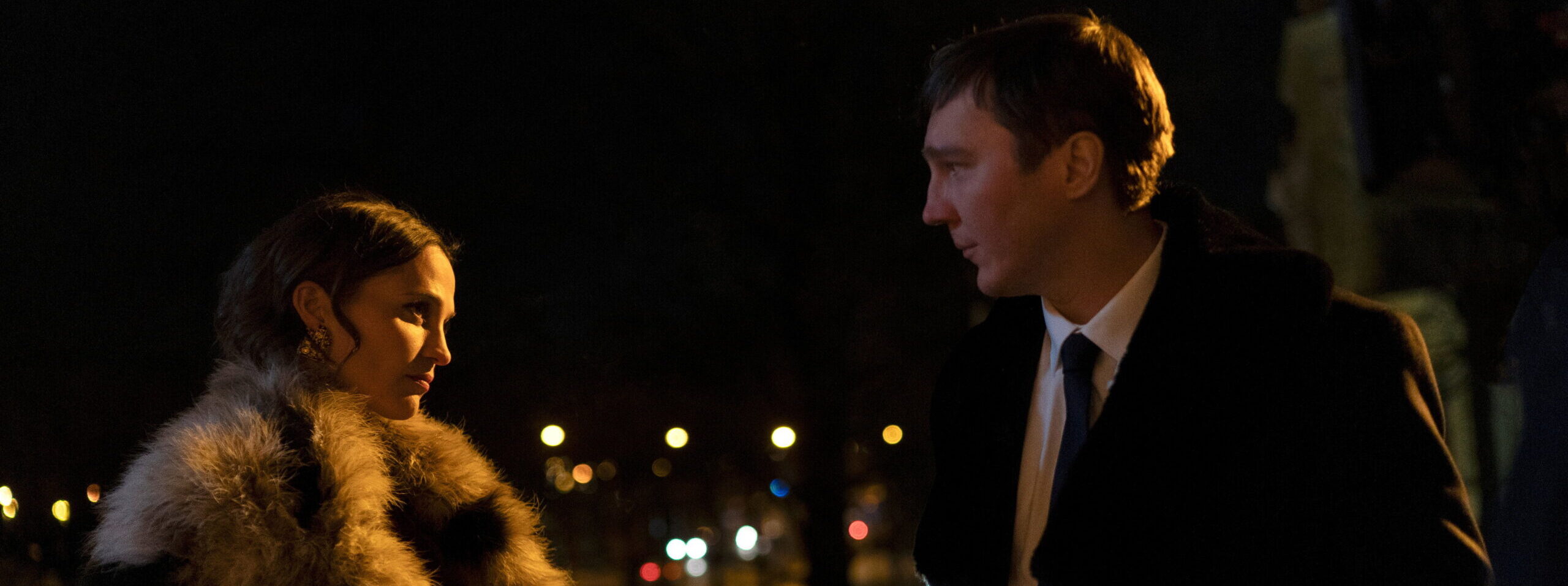
“By the time Will Keen is introduced as Boris Berezovsky, and almost immediately opens with “I’ll tell you my story”, a dose of Polonium-210 already begins to feel inviting a mere half hour into the prolonged 136-minute runtime.”
The attempts to capture some of the gaudiness of post-Soviet Russia and obscene oligarchic wealth amassed during the period keep it from dissolving totally before Jude Law’s introduction as Vladimir Putin. Law’s performance is an intriguing one, and avoids caricature. One of the terrors of his Putin is the surety with which he acts. There is rarely a line delivery which is sinister in the traditional sense, but when he spits out things such as “The unexpected is the result of incompetence” it belies a maniacal desire for power and control that underpins many of his actions. A heady combination of state power and personal grievance is expressed superbly, but even Law is eventually hamstrung by the film’s weak overarching creative choices.

“Law’s performance is an intriguing one, and [the] heady combination of state power and personal grievance is expressed superbly, but even Law is eventually hamstrung by the film’s weak overarching creative choices.”
The film makes the questionable decision to play out in mostly UK-accented English, and it proves ruinously distracting as well as inconsistent across characters (with some minor ones opting for the more conventional Russian-accented version). When Berezovsky and Baranov sit down in a posh London establishment to discuss the former’s exile from Russia – a culmination of many years of Russian internal politics – with the timbre of cocksure Oxbridge graduates, it’s almost laughably incongruous.
Assayas co-wrote the screenplay with Emmanuel Carrère, and their leaden script, dense with historical summary and over explanation, required more visual flair and cinematic elegance than Assayas goes on to muster from the director’s chair. The story positions itself to examine the effect of proximity to power, and to reveal the layers of that idea hiding inside the largest doll in the nest, embodied by Putin. Baranov explicitly states that if wealth is the currency of the West, power is the currency of the old East. However, the script languishes in dense political language that drains it of the existential stakes it wants to set. If your film’s opening talks of “visionaries”, and draws an explicit link between the modern tech oligarchs and historical dictatorships, it needs more tangible language than Baranov’s exclamation that “Russia dreams of verticality”. Assayas doesn’t fill the script’s void with a visually articulate alternative.
There are elements worth taking in, such as Law’s performance. However, the set of matryoshka dolls nesting inside THE WIZARD OF THE KREMLIN conjures little more than a listless visual style, unbearably dull script, and weak thematic delivery.