
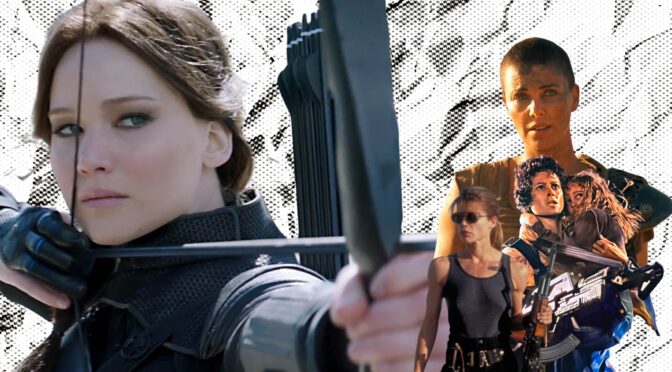
On paper, dystopia hardly seems like the ideal genre for crowd-pleasing blockbusters or Sunday afternoon classics. Corrupt governments, environmental disasters and widespread inequality are rampant enough in the news, let alone in our entertainment. The genre remains ever popular, evolving from its ‘classic’ era, including novels 1984 and Brave New World, and surviving fatigue following the early 2010s ‘young adult’ dystopian boom that began with THE HUNGER GAMES.
Dystopian films will always endure, in their own sometimes scrappy way, offering a safe way to explore the end of the world. Perhaps another reason for the genre’s continued success is that dystopian films offer some of the more interesting, if not more complex, female characters. A dystopian setting is defined by its failures, and when the protagonist is a direct victim of its injustices, the inequality becomes all the more poignant.
THE HUNGER GAMES is set in a dystopian future version of North America, split into districts by the ruling Capitol. Katniss lives in the most impoverished, District 12, populated by coal miners and reminiscent of Appalachia during the Great Depression. Katniss serves as the breadwinner for her family, taking up this traditionally masculine role after her father died in a mining accident. She keeps her family fed with illegal game and makes the ultimate sacrifice in giving herself up to be ‘reaped’ for the titular games in the place of her little sister. Throughout the series, Katniss is characterised as practical, tough and capable. She is not objectified more than any other character, as all district bodies are controlled by the Capitol. For all Panem’s many faults, their society seems to be an ‘equal dystopia’, where lower-class men and women are oppressed all the same.

“For all Panem’s many faults, their society seems to be an ‘equal dystopia’, where lower-class men and women are oppressed all the same.”
Perhaps then, these films are suggesting that female characters must become ‘masculinised’ to become heroes in their stories, which can certainly be argued for in the case of THE TERMINATOR franchise. While the films are primarily set in the modern era, the threat of an A.I. apocalypse in the near future motivates the plot. Without the help of Kyle Reese in TERMINATOR 2: JUDGEMENT DAY, Sarah Connor must become the hero. Connor undergoes a massive physical transformation, in heavy contrast to her former damsel-in-distress role (a topic covered in depth on Pod With Us If You Want to Live’s second episode on the series). In the sequel, this heroine weighs her goal of preventing the apocalypse against mothering her son. Susan Jeffords argued that one of the key narrative devices of T2 is inversion, as Connor swaps places with the T-800 who takes on the stereotypically feminine caregiving role. Similarly, in ALIENS, Ripley is again forced to take up arms when the hyper-macho Marine Corps sent to investigate the lost colony on LV-426 prove utterly ineffective against its alien inhabitants. Connor and Ripley’s ‘masculinised’ action hero status is signified through their possession of ‘male icons’: guns and muscles. In any case, while these characters may be forced into the ‘masculine role’ by a lack of male heroes it is undeniable that they excel at this task, proving to be much more competent than the baker boys or Space Marines around them.
To win the games, Katniss must become a beautiful gladiator. She has to perform likeability and femininity to the Capitol audience to win sponsors, attending mandatory makeovers and talk show appearances. Of the series, Anita Sarkeesian states that ‘real world concerns and priority of family and survival are put into sharp contrast with the superficial values imposed on her by the Capitol government.’ This superficiality extends to a fictional romance between her and a fellow contestant, Peeta. In later films a fake pregnancy is invented to win more sympathy and favours from the Capitol. In this way, the female body becomes another weapon to be used for her survival, just as effective as her signature bow and arrow.
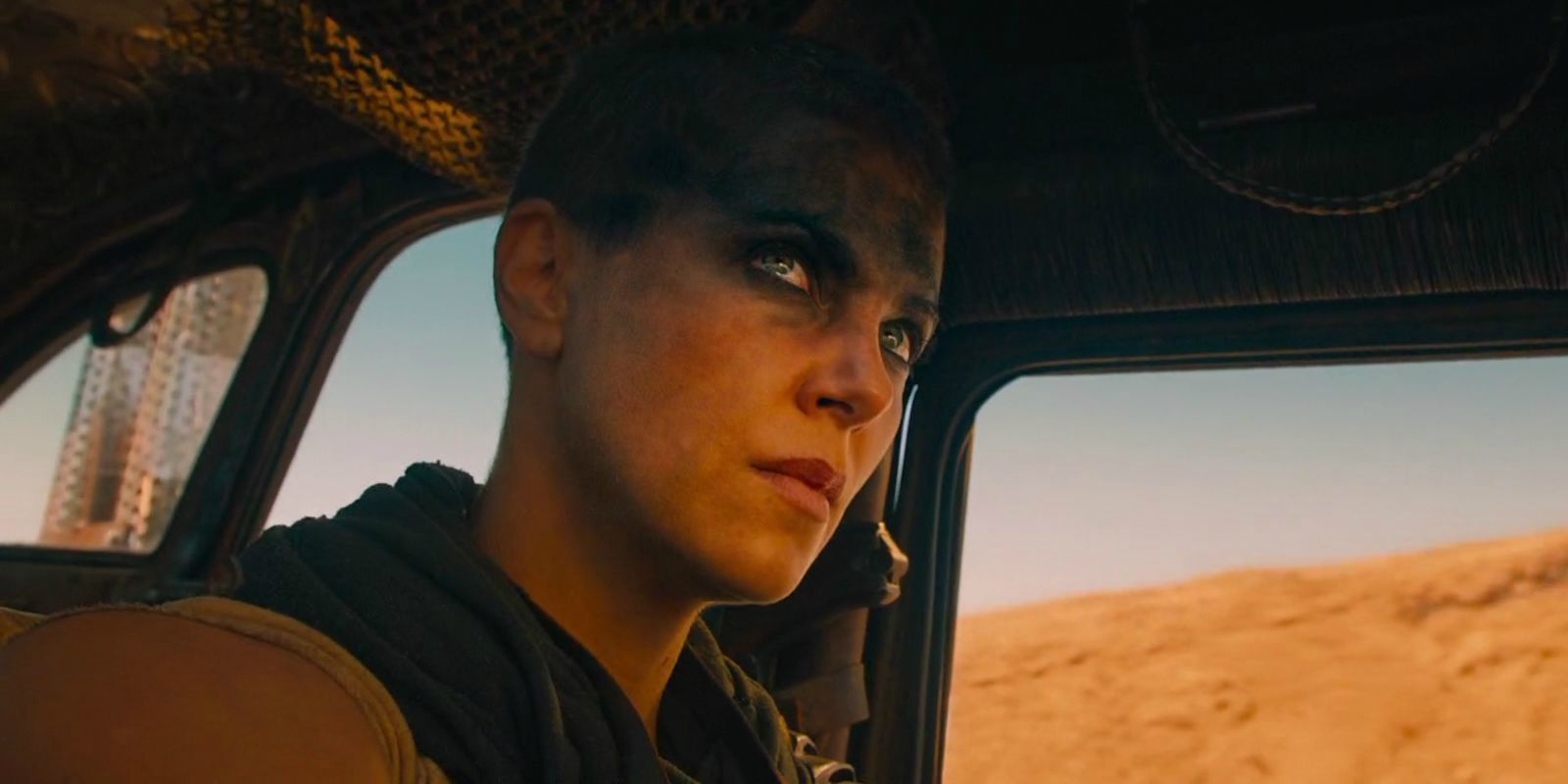
“Likewise, in MAD MAX: FURY ROAD, power in this story is leveraged and exerted through female bodies.”
Likewise, in MAD MAX: FURY ROAD, power in this story is leveraged and exerted through female bodies. The future is depicted as a grim wasteland, with this dystopia caused by a lack of natural resources. Warlord and leader Imortan Joe kidnaps five beautiful and mutation-free women to carry his heirs. Their captive status is evident through their lack of clothing, reduced to sexual objects by their captor. They are freed by Furiosa, a bald, one-armed warrior of justice. Even though she is played by Charlize Theron, her disabled status arguably places her outside the narrow Hollywood beauty standards. She is billed right alongside Tom Hardy in the opening credits, and his protagonist status is soon overshadowed as he becomes a supporting character in Furiosa’s story; a demotion symbolised when she uses his shoulder to steady her rifle.
Both Furiosa and Katniss’s core motivations can be considered traditionally feminine, in that they are family-centric. Katniss’s stereotypical ‘nurturing’ instincts are evident in her relationship with Rue. Her display of grief inspires rebellion throughout the districts, setting off a chain reaction that ends with the overthrow of the Capitol. In the same way, maternal instinct for an abandoned colonist child moves Ripley to become ‘Rambolina’, the action heroine she is remembered as. Arguably, Sarah Connor’s most important role in the TERMINATOR franchise is as the mother of John Connor, aka the future. Her moment of compassionate ‘weakness’, where she is unable to kill Miles Dyson is depicted as positive, especially since he becomes a powerful ally in their quest to prevent the apocalypse. These traditionally female traits create interesting story opportunities for progression as well as for moments of triumph in their narratives.
Through the eyes of oppressed characters, one can see the injustices of a dystopian world all the more starkly. While a lack of male heroes may sometimes serve as a catalyst, female heroes in dystopian films have unique opportunities to become complex compelling characters in their own rights. In a dystopian world, female status becomes its own kind of power.