
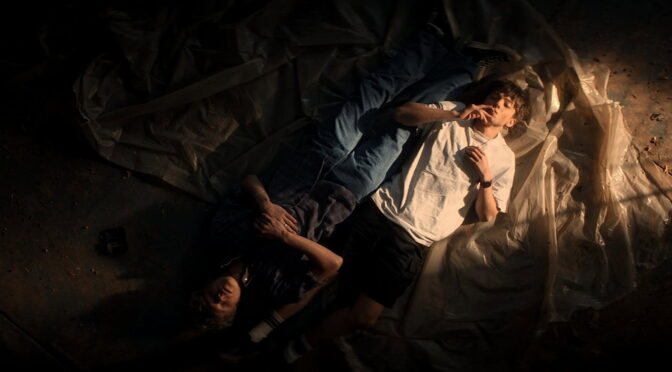
Organised religion provides many people with a place in which they feel they belong; a community of like-minded people can save a lost soul or offer hope to the lonely. That is, if you follow certain rules that prohibit many people from being themselves or simply being allowed to be attracted to whomever they want. In LEVITICUS, from debut writer director Adrian Chiarella, the idea of conversion therapy is turned into a literal, terrifying and violent real life curse in the spirit of IT FOLLOWS. After all, being gay around extreme religion can feel like hell.
Naim (Joe Bird) and his devout Christian mother Arlene (Mia Wasikowska) have recently moved to a dingy, rural Australian town. Naim feels isolated but has found solace in Ryan (Stacy Clausen), with whom he’s started a secret relationship. They regularly meet at an abandoned old building, where their alpha coded roughhousing typical of men figuring themselves out soon turns into tender romance. Their relationship must remain a secret. Their parents and everyone in town would condemn them if they found out, and, as they’re about to find out, much, much worse. The young actors have fantastic chemistry early on and there’s a pining for each other created by the forced space and small glances during church services that add immediacy and danger like first love can feel.
“This extremely clever concept is mostly carried out with confident aplomb and creates some unique and creepy circumstances…”
Only when Naim spots Ryan in an intimate moment with another boy from his school, Hunter (Jeremy Blewitt), does he then tattle to the local congregation, unwittingly forcing a dangerous form of conversation therapy upon the “guilty”. The boy’s parents hire a deliverance healer (Nicholas Hope) a religious figure with apparent supernatural powers, who seemingly utters a curse on the boys which soon becomes very real. After a scene of convulsion, reminiscent of THE EXORCIST, Ryan and Hunter are both pursued by a violent entity that takes the form of the person they desire the most; in Ryan’s case this is Naim. This extremely clever concept is mostly carried out with confident aplomb and creates some unique and creepy circumstances that make up for the surprising lack of visceral scares and more of a focus on escalating dread.
When we first learn of the entity, Chiarella smartly hinders our perception with his inventive direction and manipulation. The monster can only be seen by the person affected by the curse, and there is a fantastic early sequence where Naim follows Ryan as he talks to and engages with… nothing. This culminates in an ingenious use of Ryan in a photo booth – when the picture flashes he is kissing no-one and when Naim opens the curtain something is choking him. There is plenty of creepy fun to be had watching the boys dodge these demonic versions of each other, developing a fantastic psychological element: the protagonists, of course, do not know if what they’re seeing is real or fake, but the audience is equally baffled.
“There is a simple allegorical truth in Chiarella’s idea: homophobia begets isolation, fear, pain, and a rejection of those closest to you.”
There is a simple allegorical truth in Chiarella’s idea: homophobia begets isolation, fear, pain, and a rejection of those closest to you. “This is what they want, they want us to be scared of each other,” Ryan and his accursed doppelgänger keep telling Naim. By literally making the boys scared to go near each other it acts as some sort of castration technique, but there is hope in the narrative and the boys’ burgeoning, exciting romance. There are plenty of steamy moments, one particularly on the back of a bus that hums with the potential of getting caught. However, it also alleviates the confused pair’s fear of their sexuality because the entity is so much more dangerous by comparison. There is also a romantic and twisted line that carries the weight of the entire film’s thematic resonance: “If I’m going to live with this thing for the rest of my life, I don’t want it to look like some dickhead. I want it to look like you.” What once felt taboo can feel empowering. This nightmare could drive them apart, but it could also bring them together.
While the last third descends into moments of intense gore, they are never enough to fully shock and surprise. The film is more disquieting than it is scary, and when the extreme violence does happen its effect is blunted because it doesn’t match the carefully constructed, sinister tone of the rest of the film. However, Chiarella does nail the final shot: a fleeting view of the boys’ solidarity and the terrifying reality of their future.