
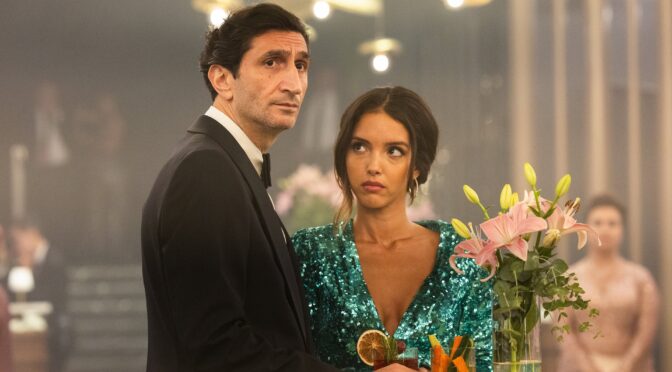
Tarik Saleh’s EAGLES OF THE REPUBLIC opens by drawing attention to the constructed nature of cinema. What appears to be the film’s beginning is revealed as a film within the film, immediately focusing the story on performance, image-making, and political manipulation.
The film centres on George Fahmy, a renowned Egyptian actor whose career and personal life become entangled with state power when he is pressured to participate in a government-backed film. George is not a typical hero; he is charismatic yet careless and often selfish, shown via interactions with his son. Initially, he prioritizes personal pleasure and public image over emotional responsibility, which intensifies the impact of his later moral crisis. Saleh does not seek unconditional admiration for George, but instead invites viewers to observe a flawed individual gradually confronting the consequences of his choices.
The film set, supposedly a space of artistic creation, becomes a site of surveillance and restriction. A state representative oversees the production, influencing what can be performed, filmed, and expressed. Because even routine production choices are subject to political approval, George appears unable to act without being watched, judged, or corrected. This sense of surveillance persists even in otherwise calm scenes. The narrative sharply mocks propaganda. George is asked to embody an idealised image of political authority, while the production prioritises spectacle over truth. The tension between the production’s polished imagery and its coercive political purpose creates some of the film’s most unsettling moments. The production therefore does more than communicate a political message: through controlled performances and flattering images, it makes authority appear desirable and legitimate.
“…Saleh examines the ambiguous territory between reluctant participation and submission, asking how many compromises a person can make before losing their sense of self…”
Visually, EAGLES OF THE REPUBLIC uses a muted yellow-brown palette that makes its interiors feel airless and visually drained. Combined with low lighting and confined compositions, the apparent warmth becomes claustrophobic rather than comforting. Close-ups of George are particularly effective, capturing his growing unease as external pressures mount. These shots allow viewers to experience his anxiety as he struggles to maintain composure. During otherwise quiet exchanges, the score frequently holds low, sustained notes beneath the dialogue, creating a sense of danger before any explicit threat appears.
“…Instead of portraying resistance as heroic, [the film] examines the subtle, often demeaning negotiations individuals make with power.”
As the state’s political pressure extends into George’s private life, the consequences of his involvement become increasingly severe. What begins as an unwanted role develops into a struggle for survival. George’s professional compromises begin to damage his private relationships, while his personal weaknesses make him increasingly vulnerable to state manipulation. Through this entanglement, Saleh examines the ambiguous territory between reluctant participation and submission, asking how many compromises a person can make before losing their sense of self and how authoritarian systems render dissent nearly impossible.
EAGLES OF THE REPUBLIC is a tense, dark political satire about how political power shapes both public images and private behaviour. Instead of portraying resistance as heroic, it examines the subtle, often demeaning negotiations individuals make with power. Saleh offers a film that reflects on both cinema and politics, prompting viewers to consider who controls the narrative, who enacts it, and what participation costs.