
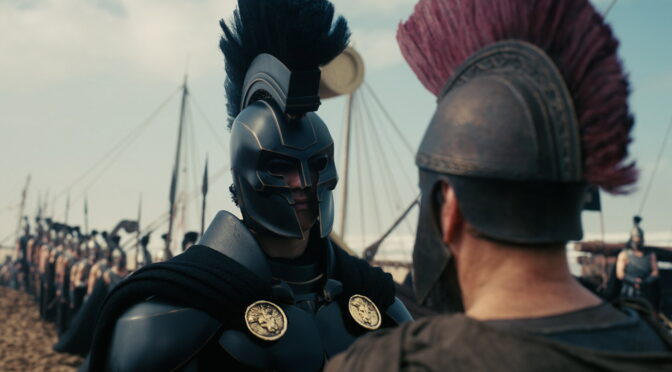
Standing almost alone in the landscape of modern cinema, few directors are making films on the scale afforded to Christopher Nolan. THE ODYSSEY feels like a culmination of sorts for the filmmaker. If elements of MEMENTO still echo through his filmography, then THE ODYSSEY shows the enduring strength of classical epics (elements of Homer’s Iliad and Virgil’s Aeneid are also realised here). Nolan’s choice to adapt the Odyssey shows the continuing influence on modern storytelling, and the technical choices are emblematic of Nolan’s domination of modern blockbuster filmmaking.
THE ODYSSEY follows the journey over many years of Odysseus (Matt Damon), the King of Ithaca, to return home after the Trojan War. In his absence, his wife, Penelope (Anne Hathaway), endures the boorishness of many suitors, whilst his son, Telemachus (Tom Holland) attempts to become a worthy heir to his father.
As with most Nolan films, the storytelling is largely non-linear. We shift between the end of the siege of Troy, Odysseus’s ill-fated journey with his men, and their encounters with the likes of Circe, the Laestrygonians, Polyphemus the Cyclops, and glimpses of post-war Ithaca shortly before his return. However, the opening of the film communicates the scale THE ODYSSEY intends to operate at.
The film begins with a depiction of perhaps the most famous of stories of Ancient Greece; that of the offering of the Trojan horse. The horse, stuck in a crooked angle in the sand, stands out against a desolate, sunlit beach, as Trojan horsemen ride towards it, bedecked in striking white armour. Despite the bacchanal of formats THE ODYSSEY is set to be released in, the striking quality of this opening shot is not the aspect ratio, some nebulously defined IMAX ‘scale’, or the tangibility of 70 mm film, but that of depth. The horse riders are far in the distance, and remain so as Sinon (Elliot Page) sprints across the dunes to explain the Greeks’ apparent peace offering.

“There is an argument that Nolan’s heightened reality style is not a good fit for ‘a time of apparent magic’, but that would be empty as a criticism.”
That sense of depth gives the film a tangibility which is engrossing. Nolan’s films are often hailed for their practical in-camera effects, with the rotating hallway in INCEPTION probably the nucleation point of this now-clichéd observation. However, Nolan’s filmography is no stranger to digital enhancement; his strength as a filmmaker is knowing when to combine digital and practical to make his films feel alive. THE ODYSSEY is perhaps the best example of this, where the terror created in the film’s depiction of the Cyclops or Charybdis and Scylla is more important than the precise mix of methodologies that brought them to screen. The sequence in the cave with the Cyclops feels like a fascinating mix of modern digital production with the revered and revolutionary creature work of Ray Harryhausen. The depiction of Circe’s transformation of Odysseus’s men into pigs is at once withholding and horrifically graphic; a finely tuned balance of obfuscation and Cronenbergian body horror.

“…the standout performance comes from Robert Pattinson as a snivelling and cowardly Antinous. [His] portrayal oscillates between smooth charm and arrogant idiocy in a wonderfully infuriating manner.”
There is an argument that Nolan’s heightened reality style is not a good fit for “a time of apparent magic”, but that would be empty as a criticism. To expect especially fantastical depictions from a director who chose to ground Batman in reality and featured the technology of Nikola Tesla in a film about rival magicians is to ignore a well-established sensibility. Nolan’s work has always been fascinated by the clash of myth and reality, whether it is Batman as a symbol, the reality of magic in THE PRESTIGE, or the horrific heroism of DUNKIRK; THE ODYSSEY is simply the latest evidence of this approach.
Among an enormous ensemble cast, Matt Damon does engaging work as Odysseus, conveying his growing sense of loss as his trials accumulate. However, the standout performance comes from Robert Pattinson as a snivelling and cowardly Antinous. As the most conniving of Penelope’s suitors, Pattinson’s portrayal oscillates between smooth charm and arrogant idiocy in a wonderfully infuriating manner. There is a valuable eclecticism and variability of demeanour, which Nolan’s scripts don’t always inherently possess.

“Polyphemus’s voice is heart-stopping in its otherworldly qualities, and the storms after the crew leave Aeaea truly feel like a new Dolby format named The Wrath of Zeus. When Odysseus plucks his bow, each new instance creates deeper emotional resonance.”
THE ODYSSEY produces easily the most effective of Nolan’s collaborations with composer Ludwig Göransson. The score avoids the tinnitus of TENET, and has a greater sense of emotional urgency than OPPENHEIMER’s, most keenly felt in the depiction of the fall of Troy. The broader sound design is also the audio work that best serves the story in Nolan’s filmography to date, with the possible exception of DUNKIRK. Polyphemus’s voice is heart-stopping in its otherworldly qualities, and the storms after the crew leave Aeaea truly feel like a new Dolby format named The Wrath of Zeus. When Odysseus plucks his bow, each new instance creates deeper emotional resonance.
Thematically, modern readings of Nolan’s adaptation are inevitably in conversation with contemporary world events, but also OPPENHEIMER (the latter a surprising blend of Nolan’s most feted non-Batman work, yet also his most political). The guilt of our protagonist and the weight of war are heavy here, just as they were for Cillian Murphy’s Oppenheimer. Odysseus’s guilt here stems from his realisation of the easiness with which the Greeks abandoned their supposed moral certainties in the face of frustration and loss. When Odysseus speaks of “ten years of rage” being unleashed upon Troy, the modern echo could be the January 6th riots, conservative spleen venting against Obama-era liberal moralising, or the dangers of a building backlash against a decade of populist reductionism. A specific modern echo is difficult to pin down, but the clear lament is the refusal to accept the lasting and profound impact of excusing our minor transgressions or not holding a mirror up to our own moral hypocrisy.

“When Odysseus speaks of “ten years of rage” being unleashed upon Troy, the modern echo […] is difficult to pin down, but the clear lament is the refusal to accept the lasting and profound impact of excusing our minor transgressions or not holding a mirror up to our own moral hypocrisy.”
The final spectre of “the people from the sea” is positioned as a neatly realised epiphany on that moral hypocrisy; a warning against the spiritual decay brought on by constant fighting. Unlike the villainous populism of Bane in THE DARK KNIGHT RISES or the corrupting individualism of OPPENHEIMER, Nolan thus turns the critique inwards with THE ODYSSEY; are the modern battlefronts in the culture wars simply a form of lotus eating, a pursuit of Pyrrhic victories while society darkens? Even if a dawn will eventually break, the sun may rise over the ruins of what we held dear.
THE ODYSSEY is a triumphant piece of filmmaking; one that fills the frame in all dimensions, spatial and emotional. The specific realisation here may be lacking in the magic some may seek from such timeless sources. However, the magic lies in the harnessing of so much cinematic craft across all disciplines to give the story a renewed power and influence with broad audiences. THE ODYSSEY depicts the homecoming of Odysseus, but perhaps it better represents the homecoming of Nolan as a storyteller.