
 LA BOLA NEGRA is a sweeping, multi-strand story of queer love, conflict perpetuating suffering, and balancing survival against complicity. Javier Calvo and Javier Ambrossi (collectively known as Los Javis) deliver a visually luxurious film, strong with symbolic imagery and emotionally charged lead and supporting performances. Although the film’s emotional eagerness is palpable, there is a melancholic beauty and ambitious structure that successfully elicit empathy and sorrow.
The film opens with Sebastián (Álvaro Lafuente Calvo, a musician credited under his stage name Guitarricadelafuente), a young man preparing to welcome Italian fascists with his trumpet and the village band in 1937 before coming under fire from their aircraft, killing his mother and many others. It’s a scene of quaint life shattered brutally by the realities of the Spanish Civil War, and encapsulates the idea that war is a destructive force, no matter what side you are on. After fleeing, Sebastián joins the Nationalist forces out of a desperation for survival.
Sebastián’s story is one of three strands in LA BOLA NEGRA, which takes its title from an unfinished work by Spanish poet Federico García Lorca. We also witness Carlos (Milo Quifes), a young man in Granada, being ‘blackballed’ in 1932 from local casino membership because of his rumoured homosexuality. In 2017, Alberto (Carlos González) is a historian tracking down remnants of queer culture from the early twentieth century while residing in Madrid with his partner Juan Pablo (Julio Torres). He receives word of inheritance from his recently deceased grandfather, which further tests his strained relationship with his mother (Lola Dueñas).
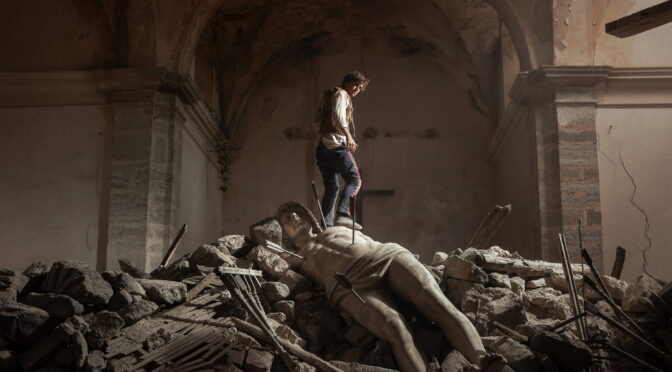
“Sebastián […] scrambling up an enormous fallen statue of Saint Sebastian[…] immediately sets up LA BOLA NEGRA as a lyrical and visually rich film, taking elements of melodrama to communicate perseverance in the face of all manner of persecution.”
From the beginning, LA BOLA NEGRA has a keen sense of historical echo and symbolism. Before the relationship between each of these strands is established, Sebastián can already be seen scrambling up an enormous fallen statue of Saint Sebastian. Besides the saint’s adoption by segments of the LGBTQ community, his martyrdom is notable for his refusal to die despite being shot with arrows after his concealed faith was brought to light. Although perhaps a little on the nose, the imagery (which is repeated throughout the opening credits which follow) immediately sets up LA BOLA NEGRA as a lyrical and visually rich film, taking elements of melodrama to communicate perseverance in the face of all manner of persecution.
Although the film is ambitious in terms of cast (there are also short but pivotal roles for Penélope Cruz and Glenn Close) and visuals, the primary challenge is a coherent structure narratively and thematically. In this case, the editing of the film delivers to allow each strand to build on each other and amplify the emotional beats across them.
After the strands are established, the precise mechanics of how they relate to one another become increasingly obvious even before they are fully expressed. However, this feels like an approach repeated across multiple elements of the film as a form of raising the emotional ante. Los Javis linger on a shot of bodies gathered by the Nationalist forces on a truck, the shouted demands to check for any still alive coming from off-screen. The single survivor, bloodied and bruised, is expected by a viewer, but the sequence’s blocking gradually reveals him in the frame. In other cases, the sound of a ‘black ball’ rolling and halting with shuddering clacks becomes the aural lead-in to another heart-shattering bark of “¡Bola negra!” The entire presentation is one of not downplaying the emotional amplitude of these stories, and the manner in which they inform each other across history.
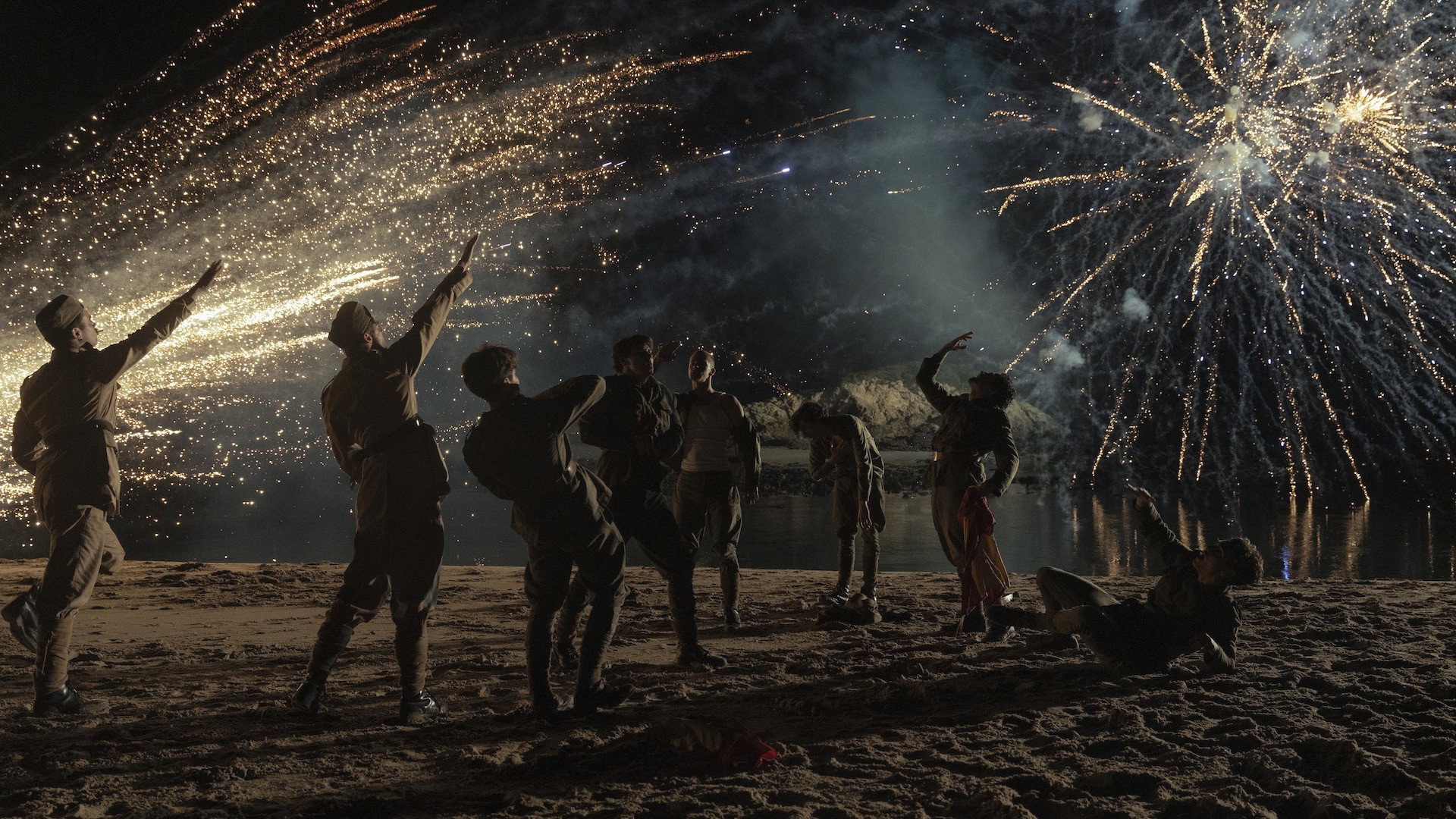
“The entire presentation is one of not downplaying the emotional amplitude of these stories, and the manner in which they inform each other across history.”
Each of Sebastian, Carlos, and Alberto has or springs from a love of art or artistic expression. Sebastian’s trumpet is a recurring vessel of his grief, played to find his sense of self in the callous identity void of war. Alberto actively seeks expressions of queer love and identity (at the outset of his story he is in modern Istanbul tracking down musical records from late Constantinople). LA BOLA NEGRA is both an example and a celebrant of such tales and works. That it does so with such accomplished handling of narrative and form deepens the impact of the story it weaves across decades.
Pedro Almodóvar’s influence can be felt here, beyond his role as an Executive Producer, and the famous director gets a playful nod when Alberto’s friends are playing a name-guessing game. The combination of queer identity, melodrama, colour, brief deployment of Cruz, and rich visual symbolism evokes his filmography clearly.
LA BOLA NEGRA posits that “too many love stories have been buried in the soil”, and although the suffering that accompanied them was buried also, the film proves they can yet bloom again into something touching.