
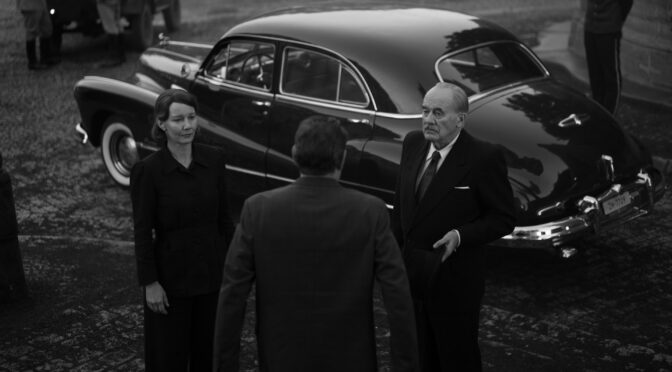
 Paweł Pawlikowski decided not to fully adapt Colm Tóibín’s The Magician, a biographical novel about Thomas Mann, when he was sent the book by his producers. Instead, one moment caught his attention: Mann’s return to Europe to accept German literary prizes in 1949, accompanied by his daughter. The result is FATHERLAND, a taut character study that ripples out from the central contradiction of its subject and typifies the director’s continuing exploration of postwar Europe’s psychic scars.
Thomas Mann is one of the most famous German authors in the nation’s history, next to Goethe – the polymath who lends his name to the two prizes awarded to Mann (Hanns Zischler) four years after the end of World War II. Goethe, as the perfect German and ultimate humanitarian, looms large, offering Mann plenty to draw on when speaking to ideologically opposed crowds in American-occupied Frankfurt and Russian-occupied Weimar.
“…Pawlikowski does not address this or the Mann children’s own Jewish heritage but uses such truths to inform organic characterisations rather than screenplay info dumps.”
Pawlikowski is wryly ambivalent to the arts’ illusion of political neutrality; the film is surprisingly funny when it overtly demonstrates the “Stalin or Mickey Mouse” question, as Thomas’ son Klaus (August Diehl) ruefully tells his sister Erika (Sandra Hüller) on the phone when she tries to convince him to join their literary road trip. Another standout mini-scene involves the scions of Richard Wagner, noted composer and antisemite, trying tone-deafly to convince Mann to speak in support of their inherited opera festival; Mann has choice words for them and for their mother (a historical titbit: this mother – a noted friend of Hitler – is believed to have helped Mann’s Jewish in-laws cross the border into Switzerland; Pawlikowski does not address this or the Mann children’s own Jewish heritage but uses such truths to inform organic characterisations rather than screenplay info dumps).
“Shot in Academy ratio and black and white, the resulting world feels out of time and place, nostalgic for a past that never was.”
Perhaps FATHERLAND relies too much on stereotypes of the conveniently amnesiac German, the square-shouldered and monolingual CIA agent, and the philosophising Russian. However, there is a fine line between truth and caricature, and sometimes the latter hides the former. This shorthand highlights the eerie, disorientating journey back to a country that welcomes the Manns with the same furore they were denounced ten years previously. Shot in Academy ratio and black and white, the resulting world feels out of time and place, nostalgic for a past that never was. As much as Thomas and Erika claim to be beyond such sentimentalities, their attachments prove to be far knottier.
Zischler’s Mann is something of an enigma, always in control of his destination and emotions and is nonplussed when everyone in his circle finds this stoicism more difficult. Hüller’s Erika, with top billing, is the film’s beating heart. Acutely aware of the world’s hypocrisies from her experiences as a queer, leftist woman in societies that pay lip service to “freedom”, a single glance at her father or a sardonic comment over a martini contains multitudes.
At a mere 82 minutes, FATHERLAND is a rich portrait of a few days in a famous life. Perhaps more accessible to those with some familiarity of the subject matter, it is nonetheless worth seeking out (and reading Mann’s and Tóibín’s works) for its exquisite artistry and layered performances.