
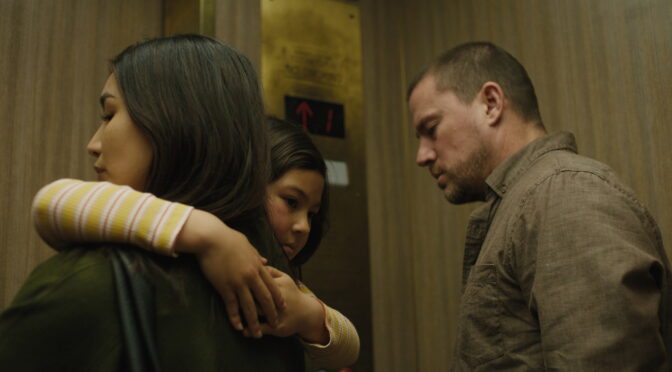
 JOSEPHINE is the unflinching story of an 8-year-old girl who witnesses a brutal sexual assault, and is an essential watch, albeit not one you’ll want to repeat. The film stars the incredible newcomer Mason Reeves, and her parents played by Gemma Chan and Channing Tatum complete the portrait of a family fractured when innocence is shattered.
Given the recent news of the Cornell Seven, the showing of JOSEPHINE at the London Film Festival this year is especially timely. But so much of what this film has to say is almost universal, including the realisation that women and their bodies aren’t protected by society. That awakening varies from person to person, and here, that horrible realisation is amplified because Josephine (Reeves) witnesses sexual abuse first hand, and at such a formative age.
The opening scenes are Josephine going out for a run with her father, to two diverging paths, and she then ends up outside public bathrooms, where a runner is chased out by a man and attacked. Everything moves fast; the woman is left sobbing and Josephine’s dad chases down the man with the police. A clever but disturbing choice of casting is that, both being half Asian, the woman (Syra McCarthy) looks like an older version of Josephine, so this horrible event is like a glimpse into her own future.
“Mason Reeves gradually hardens Josephine, who is pulled in so many directions after the incident.”
Beth de Araujo does an absolutely fantastic job directing this challenging premise, including point-of-view shots similar to RaMell Ross’ work in NICKEL BOYS. Films with a child’s-eye-view are a genre in themselves, and here, one can see visual and audio motifs similar to Charlotte Regan’s’ SCRAPPER, wielded to portray post-traumatic stress. Imagination is brought to life here, but the stories Josephine tells herself are haunted by the spectre of the rapist (Philip Ettinger), who wanders through scenes in her daily life until she learns to vanquish him. Likewise, the warping of the soundscape, which in SCRAPPER has a magical touch, here it vibrates overwhelmingly, when the memories and emotions overcome this young protagonist.
Mason Reeves gradually hardens Josephine, who is pulled in so many directions after the incident. Her mother wants to send her to a psychologist, her father wants to teach her self-defence, and on top of this, lawyers need her testimony. Meanwhile, she develops a fear of boys and men, including her unborn younger brother, and Reeves’ expressions capture this burgeoning confusion and suspicion. At one point she asks for a gun, a startling reminder of violence breeding violence in American culture.
“[Tatum and Chan] serve well as archetypes of masculine and feminine, and Tatum impresses in his ability to match Chan’s emotive and crushing performance.”
Gemma Chan and Channing Tatum are an unusual cross-pond pairing here, and their characters are so different. However, they serve well as archetypes of masculine and feminine, and Tatum impresses in his ability to match Chan’s emotive and crushing performance. Because this is Josephine’s perspective, we don’t learn a lot about her parents as individuals or how they met, her mother is a dancer, her father is a fitness buff who takes her on runs. But what they both succeed in is showing a shared helplessness. All the work done to build up their child’s confidence and make her feel safe, is undone. Suddenly, they can’t make promises they can’t keep, as she asks “what if I’m not actually stronger than I think?”.
As the case progresses in court, JOSEPHINE feels like an accurate portrayal of how long the process takes, and the good and bad of it all. Josephine is assigned a friend (Eleanore Pienta) to hold her hand, and a comfort dog called Pocket to pet, and these set her at ease. At first, she can’t handle being interviewed, and she’s thrown curveballs in cross-examination, but at the end when the female lawyer aggressively asks “why didn’t you do anything to help her?” Josephine retorts, “Why aren’t you?!”. It’s a righteous swipe at the system which protects men like this, making this film a good pair with PRIMA FACIE, which also screened at the 2026 edition of London Film Festival, in which Cynthia Erivo plays a brutal lawyer who plays a similar, frustrating role.
The first twenty minutes are graphic and triggering, but JOSEPHINE is immaculately put together. The film deftly handles the many tricky moral and emotional elements, and ends on a hopeful note: that people can look after each other and find a way to move forward in a violent world.