
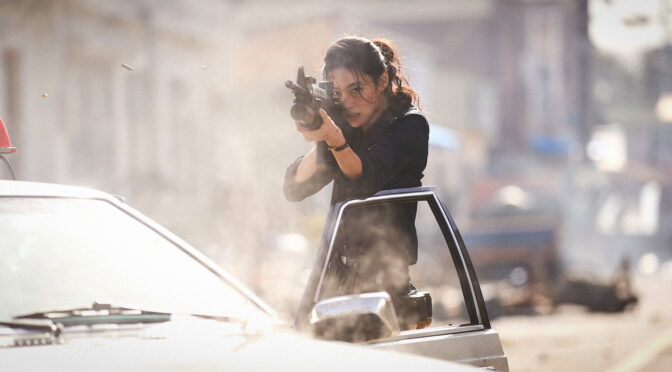
HOPE is an unapologetic, action-packed spectacle that’ll make your heart soar, flutter, and probably skip a beat. The film operates on one of the largest budgets in South Korean cinematic history and embraces what Korean cinema does best; giving audiences a wild, unhinged genre blend that subverts standard Hollywood alien invasion formulas in favour of something far more gritty and visceral. Yet, for all its thrilling energy and effortless charm, Director Na Hong-jin struggles to bridge the gap between his philosophical ambitions and the film’s relentless action.
Director Na emphasised in an interview with GoldDerby that the isolation of the setting, the rural border town of Hopo Port, is the narrative anchor of the film. As Na noted, “Isolation strengthens the feeling of intrusion, that somebody’s intruding on our space”. On this front, the first hour of HOPE succeeds brilliantly. Surrounded by minefields and isolated geographically, the intricate visual texture of Hopo Port exerts its own pull on the cast; the setting demands to be reacted to rather than simply passed through. Populated by local hunters (Zo In-sung), flawed, desperate rural police chiefs (Hwang Jung-min), and elderly townspeople, the film juxtaposes a high-tech cosmic threat against a low-tech, rugged landscape. This setup creates a compelling friction: a tight-knit, insular community forced to confront the ultimate ‘other’. This is when Na’s themes shine through most clearly, where the isolated setting helps articulate the ignorance of each character.
“Whether entirely intentional or forced by practical realities, this unpolished texture gives the film an undeniable charm where raw physical stunts are very much prioritised.”
Drawing clear inspiration from monster classics like JAWS and ALIEN, Na reveals the creature halfway through the narrative. Remarkably, the film never loses momentum after the reveal; instead, it immediately scales up the stakes. The contrast between high-concept sci-fi and restricted VFX (a limitation Na acknowledged given South Korea’s budget and high-end VFX constraints) unintentionally gives HOPE a certain third-rate B-movie aesthetic. Whether entirely intentional or forced by practical realities, this unpolished texture gives the film an undeniable charm where raw physical stunts are very much prioritised.
“Where HOPE falters is in translating its grand philosophical thesis onto the screen.”
Where HOPE falters is in translating its grand philosophical thesis onto the screen. Na has stated that his core objective was to explore human paranoia, xenophobia, and the necessity of “understanding the other”. Yet across a run time approaching three hours, these themes remain frustratingly underdeveloped. The fundamental disconnect is captured in the film’s closing invocation: “Faith is the evidence of things not seen.” Audiences are asked to make a sudden leap into existential theology after hours of heavy artillery and creature violence. Coming at the heels of two and a half hours of hunters and extraterrestrials playing an intense game of cat-and-mouse, this sudden thematic shift feels jarring. Ironically, the film hits its true emotional and thematic peak just before the finale in the haunting visual of the human hunters running along the highway, overwhelmed, silent, and unable to process or articulate what they have just witnessed. That moment captures the absurdity, horror, and disorientation of human aggression far better than the abrupt theological truths. There is a difference between trusting the audience and leaving the core work off-screen; Na’s vision is rich in interviews but the movie itself should do the heavy lifting.
There is a lot to love about this movie until the final few minutes. It’s clear that there is a sequel to be set up, but it feels like the director has been dangling a carrot in front of the audience except we are all blindfolded and are facing the opposite direction. Between the exciting and thrilling action sequences and the effortless coolness of the cast, the movie is almost begging to be loved. However, it is easy to embrace what the movie actually is: a heart-stopping energetic spectacle. The sheer fun of the cinematic experience Na creates makes its flaws much easier to forgive.