
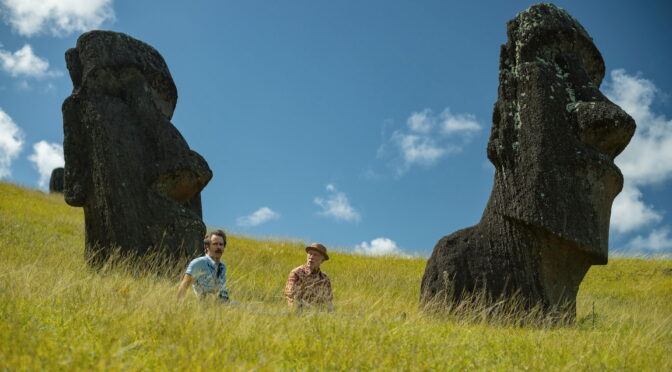
 WILD HORSE NINE harnesses a prickly but witty John Malkovich performance, along with reliable Martin McDonagh collaborator Sam Rockwell, to elevate sharp but overly familiar material. McDonagh’s latest is an amusing swipe at American imperialism, yet hews too closely to previous work to stand out in his filmography.
Malkovich leads the cast as Chris, an ageing CIA operative with terminal cancer. He and his fellow agent and friend, Lee (Rockwell), travel from Chile to Easter Island (or the native name of Rapa Nui, as a female Chilean student is keen to point out). Set shortly before the 1973 CIA-backed coup that ousted democratically elected socialist Salvador Allende and installed General Augusto Pinochet. Chris’s desire to write his memoirs, covering many sensitive operations and the time of John F. Kennedy’s assassination, is of concern to the leader of the CIA’s South American operations, MJ (Steve Buscemi).
“Malkovich’s performance is the standout element of WILD HORSE NINE, mixing confusion and melancholy with wit.”
Malkovich’s performance is the standout element of WILD HORSE NINE, mixing confusion and melancholy with wit. More interestingly, his dying operative never quite reveals his balance of feelings; whether he is regretful or proud of his covert work over his career. His casual disdain for social justice movements is both humorous and distancing, but his later affection belies some sorrow at the consequences of his actions and whether he truly feels they were a net good. Rockwell plays it straighter than he usually does, but balances that well and allows the more absurd and humorous performances around him – Malkovich, Buscemi, and Parker Posey as his wife – the space they deserve.
McDonagh’s breakout successes brought his violent and dry wit to Hollywood. However, WILD HORSE NINE, despite its easy viewing chemistry, shows how McDonagh is less interesting as a writer when not using the British and Irish isles as his vehicle. This film’s clear structural echoes with IN BRUGES make that especially apparent. The dynamic of the older, wizened partner and the younger, less beaten-down one in a notable setting they don’t fully appreciate, has a clear rhyme. The arrival of a superior to impose his violent will also has a clear analogue, between Buscemi’s MJ and Ralph Fiennes’ Harry from IN BRUGES. The same structure and framework yields much less than IN BRUGES or THE BANSHEES OF INISHERIN.
“…McDonagh is retreading some themes as well as narrative beats [and] the film’s broad thematic remit also means it inevitably focuses less on the engaging lead performances…”
When Chris lets slip some admiration for the IRA, and reflects on the role of Catholicism in his mindset, it belies that McDonagh is retreading some themes as well as narrative beats (not to mention another aside on dwarves). The film’s broad thematic remit also means it inevitably focuses less on the engaging lead performances than something like THE BANSHEES OF INISHERIN. These topics, through the lens of male friendship, violence, and regret are McDonagh’s bread and butter. However, the setting and US-focused narrative also allow the less impactful missteps of things like SEVEN PSYCHOPATHS to creep in. Similarly to this film, that US-set 2012 follow up to IN BRUGES harnessed an affecting performance from an older legend (Christopher Walken) against amusing support, but within a slightly unfocused central narrative and jumbled set of themes.
Beyond that, the film’s wit hides an overly flippant attitude to the role of US intelligence agencies in twentieth century Chilean history. Given the generations-long impact of these events, framing them within the regrets and deathbed musings of one man (albeit one man symbolic of more) with a side-order of JFK conspiracy theory is minimising. There is a regret displayed by Chris which undercuts the amorality of the institutions of which he is an avatar. The film stops short of redeeming Chris fully, but the steps taken down that path attach individual complexity to cold institutional calculations. Given the richness of films examining Pinochet’s rule in Chile, WILD HORSE NINE feels lacking in its treatment of the USA’s role. Documentary, such as Felipe Bustos Sierra’s ¡NAE PASARAN!, is an inherently more serious medium. However, other filmmakers prove a gently comedic approach, such as Felipe Carmona’s PENAL CORDILLERA, or an outright absurdist fantasy like Pablo Larraín’s EL CONDE, can yield cinematic fruit. By comparison, WILD HORSE NINE never quite resolves the scale at which it wants to operate; individuals, nations, or indeed both.
The film goes some way to addressing this in its final events, with an acerbic swipe at the role of authorities and governments and how to engage with them. A late weaponisation of Chris’s knowledge and regret to the benefit of future generations is satisfyingly cathartic, but the path there is meandering.
WILD HORSE NINE possesses some wonderful delivery from its lead actors, and delightful asides between characters that its portrait of regret and friendship allow space for. However, its muddled placement in a broader thematic picture results in a less enduring whole than Martin McDonagh’s best work.