
 In Sylvia Plath’s The Bell Jar, the protagonist imagines her various possible futures – career, family, travel – glistening like “fat purple figs” out in front of her and finds herself at a crossroads. Choosing one thing comes at the expense of the others. But what would happen were she to choose all three?
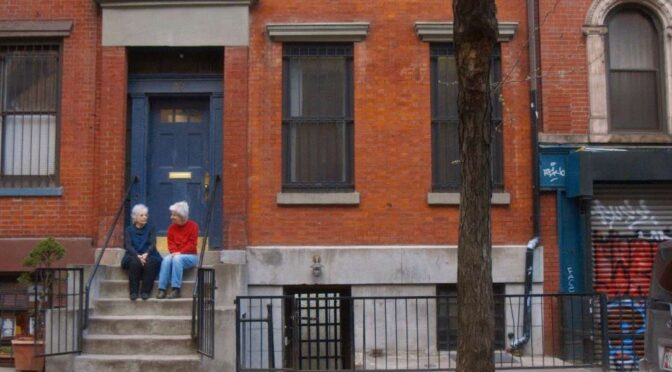
ARTISTS IN RESIDENCE explores the lives of three artists and single mothers who did just that. We follow Lois Dodd, Eleanor Magid, and Louise Kruger, who in the 1950s, set up an all-female residential studio in a downtrodden part of Manhattan. The film mixes archival footage and photos with present accounts from the women, now in their nineties, about their travails, the changing landscape of the city, and the relative sanctuary they found in coming together.
We get taken on a delicious journey of their success in the face of a hostile male world, one which made it significantly harder for them to get mortgages, or maintain professional positions. As such, we want to see them win, but as the title suggests, the film is also concerned with the price of bringing work into the home. Neither Dodd nor Kruger had beds in their apartments, only mattresses rolled up in the corner. Magid’s daughter gets emotional talking about the adult things she saw in their apartment that maybe she shouldn’t have. Asked whether her son resented her dedication, Lois says, “a certain benign amount of neglect in my life has been a very good thing” but Eleanor, a gentler member of the trio, says anyone could have set up a print shop, but not everyone could have been her daughter’s mother.
“We get taken on a delicious journey of their success in the face of a hostile male world, one which made it significantly harder for them…”
This (perhaps harsh) estimation of the choices she made for her career (for which men are judged nowhere near as harshly) forms the bittersweet tension at the heart of the film: success in one arena seems to always come at the cost of another. However, Jacobs resists coming down too strongly on either side of this question; neither too damning, nor too sentimental. The perspectives of everyone involved are probed by her to give an empathetic take that being an artist is hard, so is being a mother, and so is being alive. So, how can we make it work?
“…moving and entertaining, a beautiful insight into their lives and work, and the fierce determination it took to make it happen.”
ARTISTS IN RESIDENCE is a lively portrait of three women who made difficult decisions for their art. It is moving and entertaining, a beautiful insight into their lives and work, and the fierce determination it took to make it happen. And although they didn’t always get it right, the lifelong friendships we see depicted form the heartening backbone of the story, and allow for an alternative imagining of what family and success can mean.
At the film’s start, Lois says that if she hadn’t got divorced, she probably would have spent a lifetime supporting her husband’s career. Instead, she forged an arguably more successful one of her own. In the fig tree analogy, picking one thing means missing out another. But picking none? That will only lead everything to rot. ARTISTS IN RESIDENCE suggests there is no perfect way to live, there is just trying your best, and taking care of each other along the way. And buying a bed maybe.