
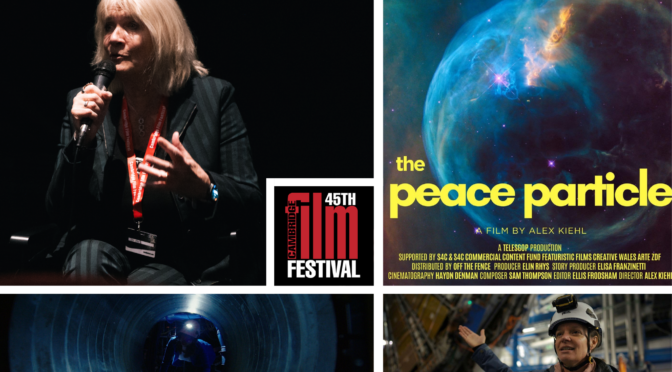
 THE PEACE PARTICLE traces the origins of CERN, Europe’s biggest physics experiment, from the ashes of atomic devastation in the 1950s to today. Intended as a 70th anniversary celebration, the crew’s approach shifted following Russia’s attack on Ukraine in 2022. CERN members react to the impact of war on the institution’s long-held community values: scientists of all backgrounds working together in one place. Making a distinct case for ‘science for peace’, producer Elin Rhys discusses the aims, and challenges, of this colourful story of science, history, humanity, and politics.
Lottie Gale: THE PEACE PARTICLE was largely an introduction for me: to CERN and its Large Hadron Collider [LHC]. Did other filmmakers share your deep connection to the project? For any novices, what drew them in, and how did they navigate new scientific territory?
Elin Rhys: I think I’m right in saying that I was the only one that had an intimate connection to CERN. Our director, Alex Kiehl – intelligent guy, with a love for physics – didn’t know much about it. In some ways, this was good because he was able to structure the film with a person who knows nothing in mind. Then, Elisa [Franzinetti], the story producer, took on a lot of research. She had a grandfather who was connected, which informed her approach.
The team were quick learners. We all spoke to innumerable scientists. By the time you get to filming, you do know a lot about it. In my job, I can become a world expert in a couple of months – and then I completely forget everything. I like that you can enter a world that is completely alien to you, that fascinates you. You might know a little a bit, but not enough. Then you get to go under people’s skin, find out what makes them tick, and why they do what they do.
You can research the facts, but what you have to find is the spirit. You only get that by talking to the people for a long time and getting to know them deeply.
LG: So, the film centres the experts that influenced the making, the research of it.
ER: We had a science advisor who appeared in the film, he was the Communications Director through a revolutionary time for CERN [James Gillies]. He has written loads of books about the organisation, including a biography of Herwig Schopper [CERN Director-General, 1981-88]. I didn’t do much of anything without him okaying it. He would often say if something wasn’t quite right.
Sometimes, you even find that two scientists working on the same project will tell you different things. When Archana Sharma [Principal Staff Scientist] says the moon will affect the LHC, Lyn Evans [Project Lead] comes up to me and says, ‘There’s no way!’, so I worried that we had an error in the film. But no; one is considering the particles around the LHC, which are affected by the moon, and one the structure itself, which isn’t.
See, there’s an awful lot of people who are pedantic about their own part – you have to balance that and please somebody, somehow.
LG: That’s also true for the audience – your scale of knowledge shouldn’t impact what you take from it, or your perspective on it.
ER: That is also the hardest bit because it is, in essence, a science film, but it’s also a history film. And it’s a human story film. It’s got touches of politics in it. But whenever there’s science in a film, people won’t watch it. ‘Oh, it’s science, I don’t understand that’.
“…we knew that as soon as Fabiola uttered [that “Electrons are red”], it injected into the team, and particularly Alex, an approach to take in the edit.”
LG: On pulling people in without alienating them, I wanted to speak to the use of colour as an entry point. From the opening interview, Fabiola [Gianotti, CERN Director- General 2016-26] speaks about the colour red.
She does! “Electrons are red”.
LG: Exactly, and this returns later when Lyn says that red means danger. It’s fascinating that colour is so celebrated in nature, for its beauty and seasonal cues. But colour also has an incredible depth of meaning in science – information, warnings, demarcation. Did this feed into your use of colour in the film?
ER: Yes, we knew that as soon as Fabiola uttered those words, it injected into the team, and particularly Alex, an approach to take in the edit.
Another interesting point with colour involves the CMS [Compact Muon Solenoid]. Its doors were close during filming, but it’s beautifully colourful. The reason is to demarcate different parts. Obviously, if you’re making a film, the colour is important, which is why there was a lot of black and white too – to depict a certain time.
Then, the graphics team did a couple of sequences going closer and closer, from these giant detectors into what is basic to nature. What I felt was remarkable is that you have these giant machines, the size of cathedrals, to find something so infinitesimally small. So, we tried to bring in the colour, but also a comparison of size. The poem at the end is supposed to lock all of that in together, the juxtaposition of the universe’s size and colour with the teeny, tiny particles that we are all made of.
LG: The montage you mention, it zooms in right down to the pupil of an eye – there is a recurring focus on the centre. When you’re thinking of such a great spectrum of scale in this film, what remains central for you?
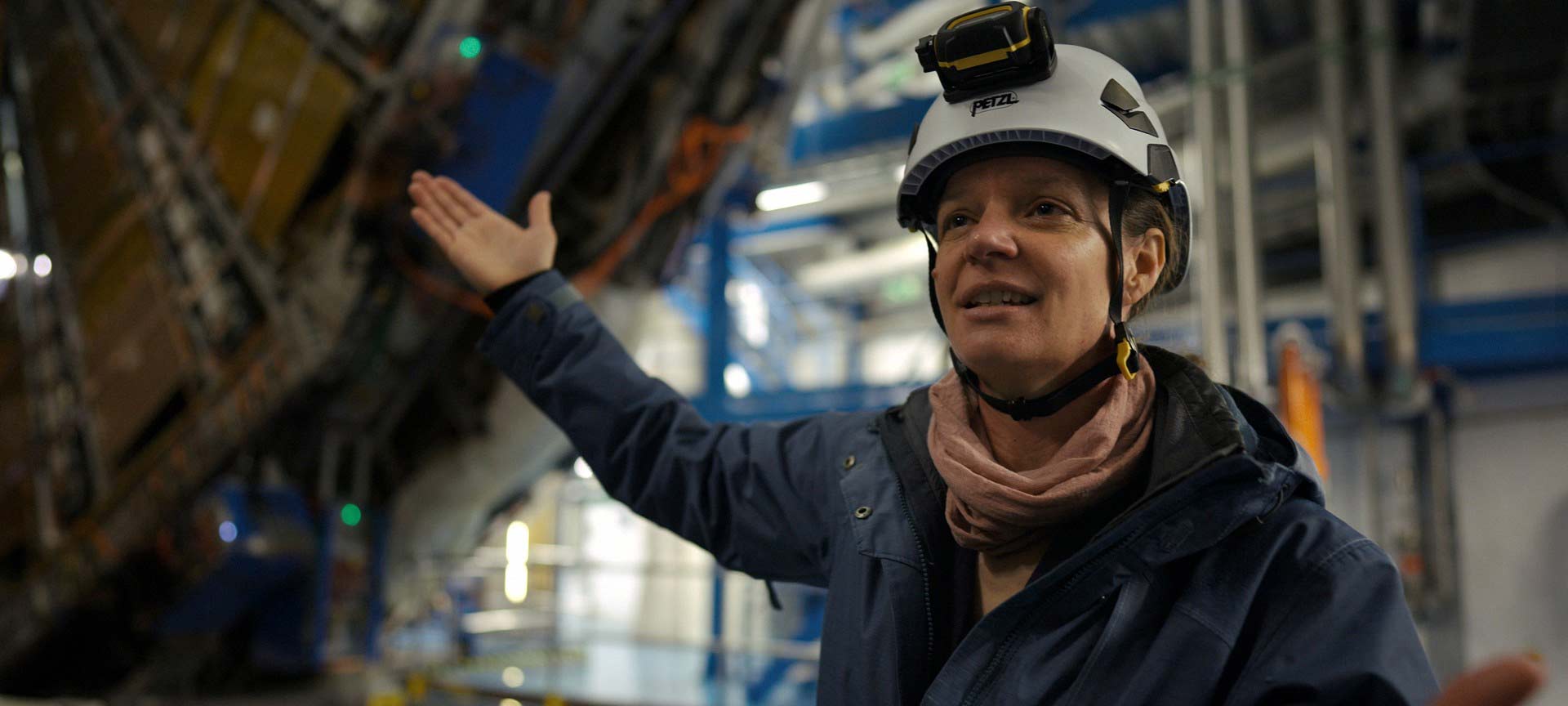
ER: What is important for me is the message: that there are places on the planet where people work together in the name of peace. And that it all happened because of Los Alamos and the atomic bomb. Had it not been for this, would CERN have ever existed? I don’t know.
It was scientists that were disgusted with what they’d done that came together to make a start; they were the founding fathers. I don’t think the film achieved saying that point as well as I would have liked it to. One of the biggest issues about making a film is knowing what is that film? What is the story that you’re actually trying to tell? THE PEACE PARTICLE was born as a history of CERN, to celebrate 70 years, and as something that started with war.
“One of the biggest issues about making a film is knowing what is that film? What is the story that you’re actually trying to tell? THE PEACE PARTICLE was born as a history of CERN, to celebrate 70 years, and as something that started with war.”
That’s how it began, but then the [Russian] invasion [of Ukraine] changed that because I got the commission before the war, and we hadn’t started making it. And yet, you can’t escape from the scientific achievements. The most interesting ‘people story’ was the finding of the Higgs [boson particle]. That is the essence of the science. And I think, if you hadn’t had that in the film, and you just talked about the history, people would have been bored.
That was built upon, to that climax when they were all cheering and clapping and crying. So, I sometimes think what is this film about? It’s about human endeavour in the name of peace.
LG: So, is that the heart of the film for you?
ER: I want there to be a message going out, saying ‘Look at this place and look what they achieve when they put politics behind them and rise above it to work together’. I also know it’s terribly naive because there is a stinking old war going on and the Russians are being absolute bastards to the Ukrainians.
Sometimes I sit there thinking about how we’re saying we’re kind of glad to still cooperate with the Russians, and part of me thinks, no. It’s complex. I don’t think any filmmaker is going to tell you that there’s a simple answer to that question.
You know, Alex would see it in a different way to me because I’m the one holding the purse strings. A producer’s perspective on a film is very different to the director’s perspective. We lost money on it because the distributor went bust. I’m still paying back a loan – there was a time a couple of months ago when I actually hated the film. I employ 30-odd people full-time, and I could see the company going under because of this film. I’m really pleased with how CERN liked the film. If they hated it, what would I have done?
So, it can shift from the morning to the night, quite frankly.
LG: I want to ask about [Robert] Oppenheimer’s role in CERN’s origins. Where does THE PEACE PARTICLE sit in dialogue with his blockbuster biopic in 2023 [by Christopher Nolan]? Is that something you entertain or reject?
ER: I entertain it. Speaking to any distributor about taking the film on, the only thing they wanted was Oppenheimer’s face on the front of the pitch. They thought they would sell it better because his face is on it.
Do I like that idea? In some ways, yes. In some ways, it moves the story forward from Oppenheimer. [Isidor] Rabi was also in OPPENHEIMER, one of the founding fathers of CERN. My favourite scene in our film is when Oppenheimer is standing alongside Heisenberg, who was Hitler’s physicist. Heisenberg was one of the first around the table to discuss CERN, joining the likes of Neils Bohr and Edoardo Amaldi.
Something I fear doesn’t come out [in THE PEACE PARTICLE], is that one of the reasons the scientists were disgusted with themselves for dropping an atomic bomb, is that most of them hadn’t intended for it to be dropped.
Many of them had written and asked why they couldn’t have dropped a bomb somewhere without people just to show how ferocious a weapon it was. Why did they have to kill so many people in the process? As Oppenheimer says, they were consumed with their own pride and then realised what they had unleashed.
I think that’s what spurred a lot of the scientists on to start something like CERN. So, I liked the fact our film was connected with OPPENHEIMER because it might have meant a wider audience, but that didn’t actually happen – it was too late. Any documentary that goes out alongside a film has got advantages. Doesn’t work the other way, not much. Big blockbusters inspire people to want to know more, so if you’ve got a documentary coming up, it’s good. I do approve of that.
LG: You mentioned you’d like to make a future project about Fabiola. I valued her introduction in THE PEACE PARTICLE, which avoids labelling her as CERN’s first female Director-General. Was that important to you?
ER: Yes, exactly. The archive footage too, including women scientists.
LG: Would you agree that this is improving in film, including women without explicitly addressing gendered context for relevancy?
ER: I take your point, but there’s been a generation of women who are invisible. Lise Meitner, for instance, was another person I’d love to make a film about, but there’s not enough archive.
She understood nuclear fission, which enabled the bomb to happen. She wasn’t allowed to work in a lab [in Berlin] because she was a woman, so they built her a lab in the cellar.
The other people working on the project, who revered her and knew that she was on top of her game, won the Nobel. She wasn’t included. I’m of the generation of women who saw way more of that than you will.
And there’s part of me still that can’t get away from that. Wanting to make a point. The way we did that here is by including lots of shots with women. All the spokespeople, except Jeffrey Hanks of ALPHA, were women. No song and dance, they are just there. But when you go back to the distant past, I think there are stories to be told there that you do have to point out.
Fabiola wanted to be a ballerina until she read a book about Marie Curie, who, in herself, is so unique. You know Curie’s son-in-law kept his wife’s surname, [Frédéric] Joliot-Curie, because he thought her fame could advance him? And that’s in the late 1920s.
LG: When it comes to stories of women in history, there is so much to uncover and celebrate – but not belittle.
ER: I agree with you that we should reach a state where it’s just normal. But I came from a time when it wasn’t, and when you’re talking about the history, I think sometimes you do have to point out what used to happen.
Just this week, there was the news that out of 86 scientists named in the GCSE syllabus, only one is a woman – Rosalind Franklin. We still have a long way to go.
LG: That’s why it’s time for Fabiola’s film next, you can feed into the new generation.
ER: I’m trying to get funding for it. You know, she signs off her emails with ‘lots of love’. Every time, I want to take a photo and put it on the wall.
LG: That’s amazing. We need her story even more now.