
In England, a staggering 92% of land and 97% of all rivers are not legally accessible to the public. OUR LAND delves into the Right to Roam debate over whether English land access laws should be reformed. We hear from campaigners at the heart of the movement and the landowners who have a range of concerns about this ask. While repetitive at times and lacking a strong finale, the film is a beautifully shot tribute to the beauty of the English countryside. The documentary’s success lies in its function as a starting point for further conversations among viewers, prompted by the meandering coverage of numerous perspectives regarding a broad range of themes around public access to nature.
OUR LAND began as a seed of an idea that germinated on a lockdown walk. Director Orban Wallace and producer Leo Smith got in contact with Nick Hayes (author of ‘The Right to Trespass’) and the project grew into a five-year-long endeavour to capture the movement for greater land rights in England.
The colourful character of Francis Fulford drives the film. He is a living caricature of the empire-loving upper-class, his eccentricities providing comedic relief from his bigoted beliefs. Not all estate owners are as unsympathetic to the Right to Roam movement, however: John Mildmay-White is deeply interested in the debate and believes in allowing access. However, he caveats this by saying it must be controlled, citing concerns about the public acting irresponsibly on the land.
Gaining access to film estate owners was a challenge; Wallace says that they spoke to around thirty landowners who said similar things to Fulford, however most of them declined to be filmed. “I’m amazed you’re doing this,” says the father-in-law of estate owner Mildmay-White in the film, “You know what they do: they end up making you look like an upper-class twit.”
“Sweeping shots of Highclere Estate in dusky light […] reveal the beauty of the English countryside that is hidden behind boundaries of impenetrable hedge.”
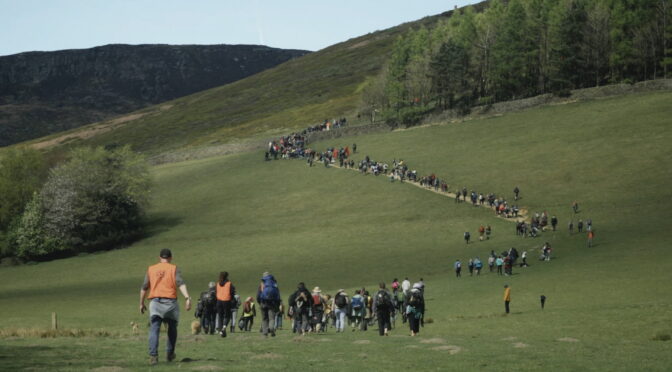
Alongside hearing from the estate owners, we are transported into the heart of the Right to Roam campaign, spending time with its central members: Nadia Sheikh, Nick Hayes, and Guy Shrubsole. We travel with them as they embark on solitary and mass trespasses. Walking with them, we learn how gates, fences, paths, and signs dictate movement on the land. The trepidation that accompanies these trespasses contrasts against the peaceful forests, streams, and meadows we are shown. Sweeping shots of Highclere Estate in dusky light, the house peeking out as a flash of light stone in a vast dark forest, reveal the beauty of the English countryside that is hidden behind boundaries of impenetrable hedge.
A significant moment is when we are taken to Rothiemurchus Estate in Scotland, where the right to roam is already enshrined in law. In the Land Reform Scotland Act 2003, everyone has access rights as long as they are exercised responsibly. Here, estate owner John Grant provides a clinch to the arguments of the English landowners: he sees his responsibility as the land manager to make sure that people are informed of their responsibilities, and when they are, he finds that people do respect the land. As he drives around the estate, we see campers, walkers, and people sitting and enjoying the beautiful views of Loch an Eilein, a stark contrast to the empty English estates through which we have trespassed.
The film is structured like a video essay, with scenes ordered according to argumentative theme and sewn together with quotes that provide alternate opinions on the point in question. The form itself does not judge different sides of the issue, opting to let them speak for themselves.
While this provides a rich overview of the debate, in some places the collaging of soundbites becomes repetitive. For example, the finale of the film is composed of clips of preceding interviews, which rehash points that have already been made. This is an unsatisfactory conclusion, failing to build upon the drama created earlier in the film by Daniel Inzani’s soundtrack to create some kind of emotional crescendo.
“While the Right to Roam debate is the focus, it is revealed to be a lightning rod for all kinds of issues about class, colonisation, race, land ownership and our connection with nature in England.”
While the Right to Roam debate is the focus, it is revealed to be a lightning rod for all kinds of issues about class, colonisation, race, land ownership and our connection with nature in England. The documentary leans into this: a beautiful story of the history of land enclosures and its links to class sets the tone of the film (animated by May Kindred Boothby and written by Robert Macfarlane). Wallace has described the film as a ‘character-led’ documentary, with the contrast between the upper-class characters in their stately mansions and the nature-loving ‘peasants’ living in houseboats and small flats forming the backbone of the film.
Later, the links between the British Empire and the wealth of the estates are woven in. The film explores how this history continues to shape the relationship of people of colour in England to the countryside, and hinders their access to nature.
For such a comprehensive documentary, there is an odd omission. The film talks about public land access on a national scale: it highlights that only 8% of land is legally publicly accessible in England and discusses changes in English law. As the film focuses on estate owners, it is easy to infer that the majority of inaccessible land in England is part of estates. However, this is not the case at all: estate owners own 30% of England’s land, with the rest being owned by corporations, oligarchs, city bankers, and other entities. This fact should have at least been mentioned in the film, as it is important context. Despite this omission, OUR LAND is a sweeping exploration of the relationship between the people of England and their land.