
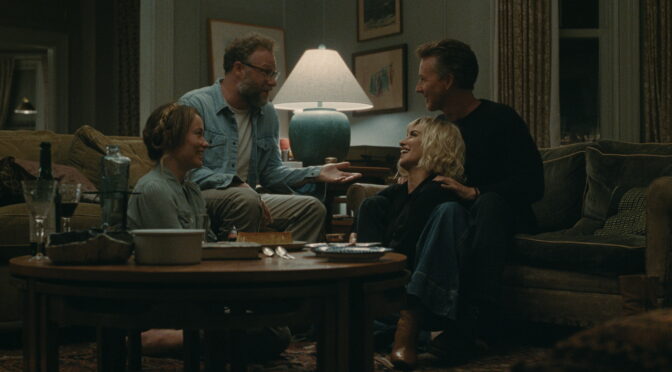
THE INVITE is a dialogue-driven comedy spanning one night at a dinner party. Angela (Olivia Wilde) and Joe (Seth Rogen) met when they were two young artists and have since grown into bickering, resentful adults. When Angela insists they host their elusive upstairs neighbours for dinner, Hawk (Edward Norton) and Pìna (Penélope Cruz), the night evolves into an unexpected proposition that challenges their relationships.
THE INVITE is a promising recovery for Wilde as a director, adapting the 2020 Spanish film THE PEOPLE UPSTAIRS. While her last film, DON’T WORRY DARLING, earned criticism for its convoluted third act and surface-level exploration of its themes, THE INVITE scales back, focusing on complex characters and nuanced interrogations of modern relationships. The film’s setup is simple. It progresses solely through the interactions between the four characters, almost entirely within the single setting of Angela and Joe’s San Francisco apartment. But even with this relatively bare structure, the film delivers compelling character exploration and gripping atmospheric tension. The bold comedic style feels incredibly well-balanced against emotional sensibility. The performances are captivating without ever leaning into absurdity. The direction and score guide the tension of the story without smothering it in overdramatisation. It is the harmony of all these elements that makes THE INVITE so effective.

The opening sequence immediately sets the tone for the film. Joe returns home from a monotonous day at work as a music teacher, and he and Angela begin bickering from the moment he opens the door. A flustered Angela reminds Joe that the neighbours are coming over that night, and Joe forgot the wine like she asked. Joe wants nothing to do with the neighbours and confronts his wife with a list of complaints. They volley insults back and forth—quick, cruel, and relentless. The score plays a vital role in ramping up the tension, an agitating rhythm amplifying Angela’s constant neurosis and Joe’s hostility.
“Throughout the film, Wilde expertly uses the architecture of the space to frame relationship dynamics and drive tension.”
Throughout the film, Wilde expertly uses the architecture of the space to frame relationship dynamics and drive tension. Doorways and imposing walls induce a sense of claustrophobia, like the way the narrow entry hallway visually confines Joe as he argues with Angela standing siphoned off in the kitchen. Wilde also plays with a window motif to contrast with the solid, restrictive frames, often appearing when characters expose their vulnerabilities. The direction is crucial in building the atmosphere of THE INVITE; a mess of awkwardness, resentment, and guilty desires brought alive in the space.
A prominent force in the film is the performances. In addition to their effortless comedic chemistry, all four characters feel distinct and complex, each layered with their own insecurities and desires. Norton’s Hawk is particularly strong. He exudes confidence and charisma, but we see that persona falter slightly at times. Hawk has one monologue later in the film that offers a noticeable tonal shift, and yet it manages to feel organic.
“Where THE INVITE really sticks the landing is in its thematic exploration of relationships.”
Where THE INVITE really sticks the landing is in its thematic exploration of relationships. As the evening progresses for Angela and Joe, Hawk and Pìna’s free-spirited, sexually liberated relationship becomes a lens through which they interrogate their own. Angela and Joe constantly argue, they never have sex, and they seem to have forgotten what it was like to be energetic and infatuated like their neighbours appear to be. Angela and Joe reckon with the reality that their own choices and attitudes shaped what they have become. Hawk and Pìna might be temporarily convinced they can help them find it again, but Hawk and Pìna’s relationship can be—and is—picked apart, too.
THE INVITE never commits to an entirely optimistic or pessimistic view, instead leaving room for the audience to draw their own conclusions. With this nuanced perspective, THE INVITE elevates itself into a surprisingly affecting examination of love.