
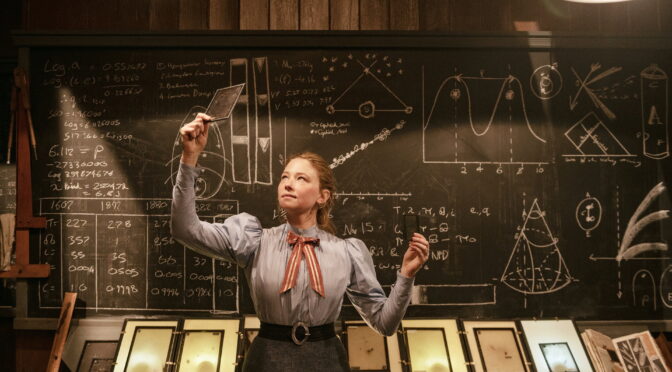
 A novel of over 500 pages becomes a sub-90-minute film in VIRGINIA WOOLF’S NIGHT AND DAY, turning four multi-faceted characters into a charming but one-dimensional heroine’s journey. This 2026 film based on the 1919 book adds entertaining anachronisms and dramatic storylines to suit its new medium; some of these choices land, others are not given the time to warrant their daring.
Katherine Hilbury (Haley Bennett) could be mistaken for a dreamer, always gazing up at the stars, but she’s a realist, carefully calculating astronomical distances through the dimming of stars. It is a closely guarded secret, as she witnesses the rampant misogyny of the Royal Astronomical Society, and her father (Timothy Spall) pressures her to accept a proposal from her oldest friend, the bumbling poet William Rodney (Jack Whitehall).
The situation is a recognisable dilemma for female viewers still tackling patriarchy: can a woman have a career and find love? Here, it is told from the perspective of a woman in 1910, still waiting for the right to vote, let alone study or publish under her own name. Writer and producer Justine Waddell recognises the long lasting impact of Woolf’s feminist legacy, having her characters discuss her guess “that Anon, who wrote so many poems without signing them was a woman” and through suffragette Mary Datchett (Lily Allen) giving Katherine a quiet place to work on her thesis, actualising the importance of a Woolf’s titular desire for a Room of One’s Own.
“…a passion for social justice in the writing of this film means it takes a very slow, quiet novel of middle-class romantic vacillation, and overcorrects to introduce too much melodrama…”
But a passion for social justice in the writing of this film means it takes a very slow, quiet novel of middle-class romantic vacillation, and overcorrects to introduce too much melodrama, a misfire for a film marketed as “an un-romantic comedy” and Virginia Woolf’s “funniest novel”. Cyril Otway’s (Misia Butler) storyline, for instance (the hybridisation of a sympathetic cousin and a rebellious one in the book) is startlingly heartbreaking. It also turns Mr Hilbury into a villain, and though Spall beautifully delivers the realisation “Time passes” (a reference to Part II of the novel To The Lighthouse), he isn’t given enough screentime to reveal his motivations or fully develop this character arc.
There’s an extra effort to ground the story in historical context, like the singing of Ethel Smyth’s March of the Women at Mary’s Suffragette meeting. But the film also gets mixed up. For example, the publication of Henrietta Swan Leavitt’s paper didn’t precede the flyby of Halley’s Comet, undermining these efforts to include facts. It is perhaps for the best that the film doesn’t try and foreshadow World War I, as it already juggles so many other political ideas.
Though it is empowering to watch, one frustrating element is the film’s need for women to succeed, rather than just exist. ‘Night’ and ‘Day’ is meant to symbolise the difference between the romantic and the rational, and how they can coexist, professional triumphs are secondary to the self-discovery these characters go through. However, a highlight is seeing Mrs Hilbury (Jennifer Saunders) finally publish a biography of her father, the poet, with the help of Ralph Dunham (Elyas M’Barek) – the connection between an editor who takes their writer seriously and uplifts them is underrated and delightful to see on screen.
“The best part of the film is the anachronistic costuming, with Haley Bennett rocking several fantastic outfits including lavish hats, lace collars and excellent sunglasses…”
The best part of the film is the anachronistic costuming, with Haley Bennett rocking several fantastic outfits including lavish hats, lace collars and excellent sunglasses, while Lily Allen completely overturns the time period with red dyed hair. While Katherine dresses as a man to experience new freedoms, it is sad that Mary’s love of shirts, trousers and braces is undiscussed. In order to introduce the arc of Katherine versus the academic establishment, Mary’s personality and activism, and her character in general, falls by the wayside, a shame when she steals every scene she is in.
Night and Day is a Woolf novel that precedes the abstract stream-of-consciousness style she became known for, but she still gives Katherine, Ralph, William, and Mary plenty of complexity and contradictions. VIRGINIA WOOLF’S NIGHT AND DAY does its best to do this headlining authoress justice, taking modern risks with an Edwardian story, and it is really fun; fans of CYRANO understand how beautifully Haley Bennett can portray passion and it is pleasantly surprising how excellent Jack Whitehall is. However, it misses the mark with what makes Woolf great, which is giving these characters breathing room to be multi-dimensional.